
A two-person crew must move a 74 pound inverter from the delivery pallet across a gravel yard to an equipment wall, then lift it onto a bracket at chest height. Company policy requires two people or wheeled equipment above fifty pounds, and the loose gravel is too soft for the pallet jack. The lifting rule also says to keep the load close to the body and turn the feet instead of twisting. Which handling approach meets the weight limit, the surface condition, and the body-positioning rule for this move?
Select an answer to reveal the explanation.
Short Explanation
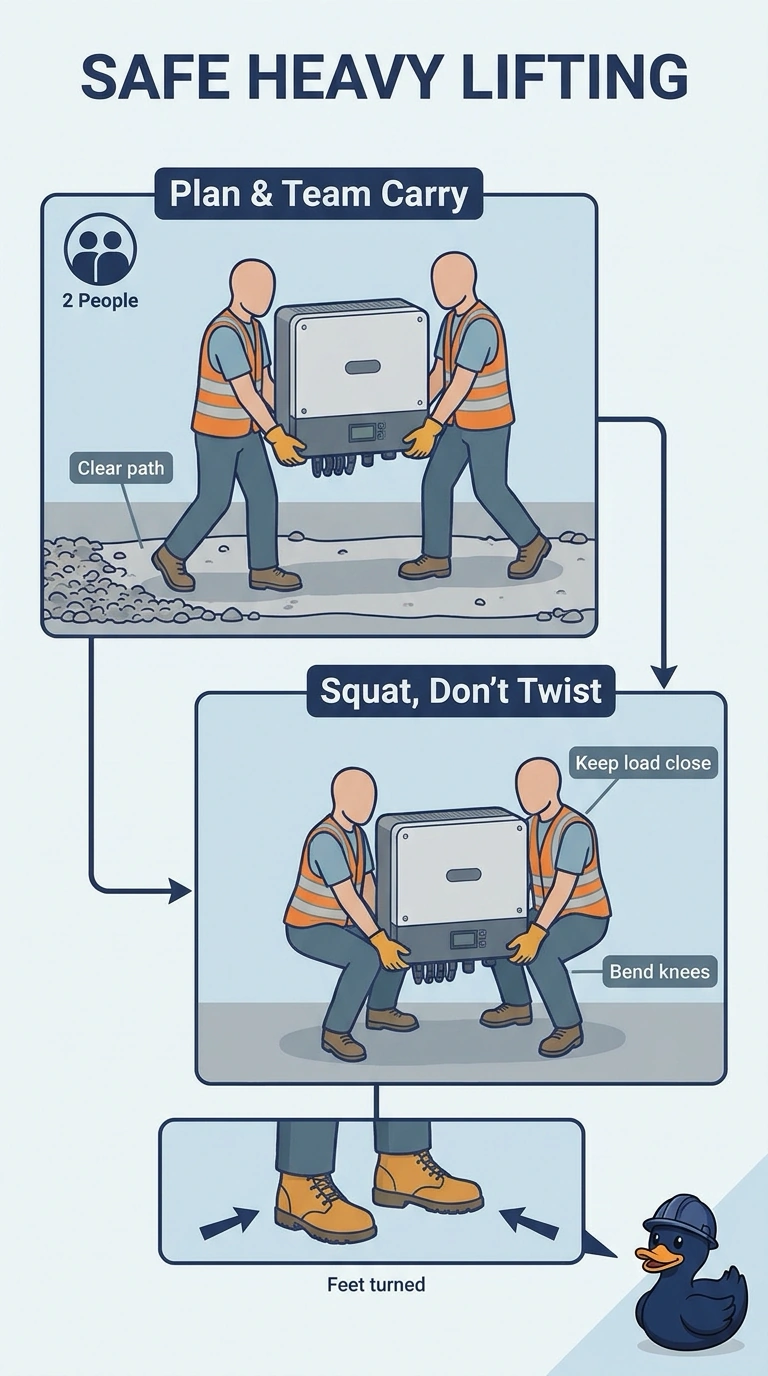
You and your partner should carry the 74-pound inverter by hand across the loose gravel, then lift it together from a squat with the load close and your feet turned toward the bracket. That meets the weight limit and keeps you from twisting as you set it down.
Full Explanation
Carrying the 74-pound inverter by hand with two people meets the company’s weight rule, and lifting together from a squat with the load close and your feet turned follows the body-positioning guidance. Holding the inverter slightly forward while lifting would put the load farther from your bodies, increasing strain even though two people carry it and turn their feet. Keeping the inverter close but pivoting your torsos to line it up would violate the rule against twisting under load; step around instead. Securing the inverter on a two-wheel hand truck would use wheeled equipment, but its wheels may sink or snag in the loose gravel, making the route unstable. The hand carry avoids that surface problem while still using two people for the heavy move. Exam caveat: equipment that works on a firm floor may be unsuitable on loose gravel, so consider the actual route as well as the load’s weight. Practical check: before moving, agree on the lift and set-down commands, check the path, and make sure both people can keep the inverter close while stepping to face the bracket.