
An associate assists opening a residential AC disconnect before cleaning an inverter, the circuit feeds from a main panel across the garage, and tools and a ladder crowd the working space. Which de-energization, lockout/tagout and working-clearance practice best protects the crew?
Select an answer to reveal the explanation.
Short Explanation
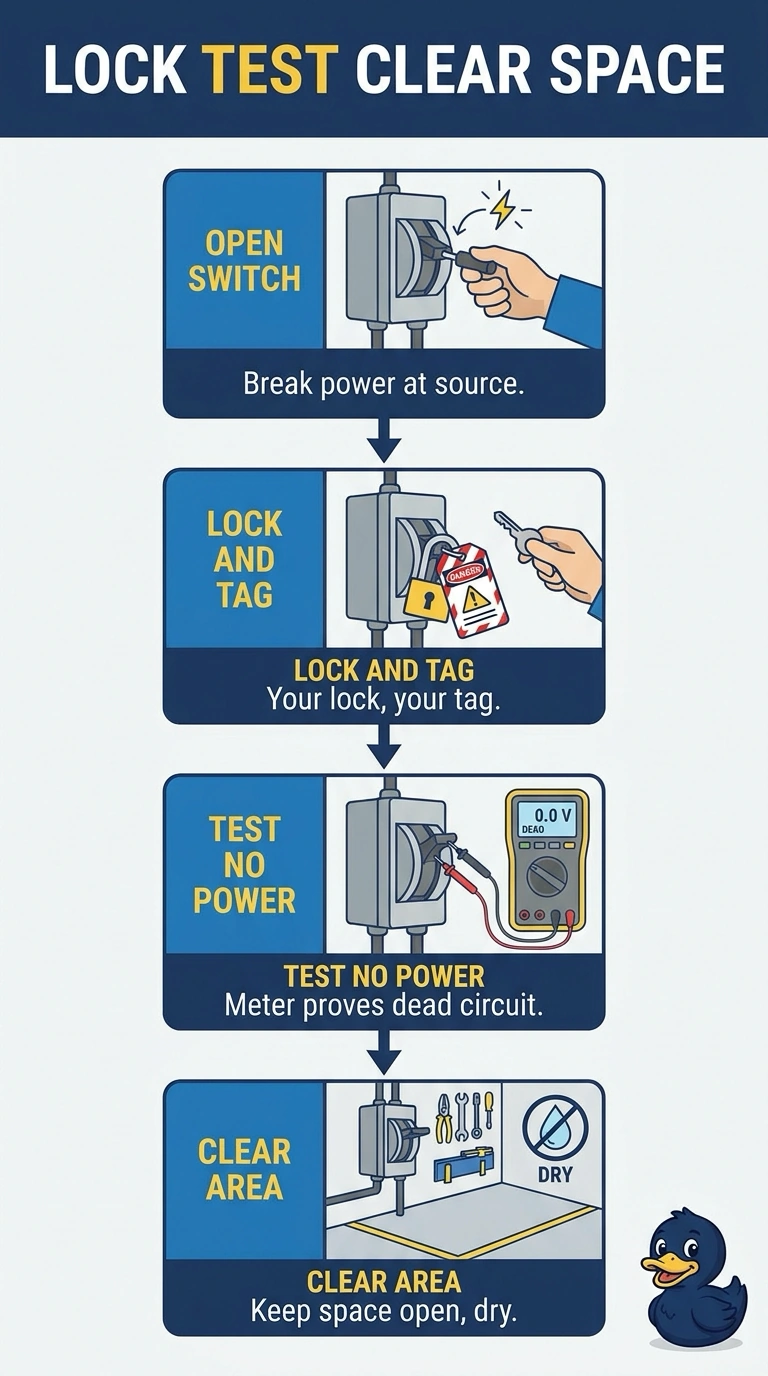
You protect yourself and your crew by treating the circuit as energized until you verify it is safe. Isolation means locking and tagging the disconnect, testing for absence of voltage, and clearing the work space before cleaning.
Full Explanation
The practice that opens the residential disconnect, applies a personal lock and tag, tests for absence of voltage, and clears the work space best protects the crew. It secures the local isolation, verifies the electrical hazard is absent before contact, and keeps access unobstructed. Merely confirming that the disconnect handle is OFF does not prove the circuit is de-energized: failed contacts, incorrect identification, or another source could leave parts energized, so an absence-of-voltage test is essential. Locking and tagging the disconnect and testing voltage while leaving a ladder within required working clearance still creates an obstruction that can restrict access or egress and interfere with safe work; the space must be cleared. Locking the identified main-panel breaker, tagging it, and testing at the inverter may provide upstream isolation, but it does not open and secure the local disconnect specified for this task. Exam caveat: an inverter installation may have additional energy sources or stored energy, so opening one disconnect does not automatically make every part safe. Practical check: use an appropriately rated tester, prove it on a known source before and after testing, and confirm required clearance against applicable rules and equipment instructions.