
A new sales rep shadows you on a home with rooftop DC strings feeding an inverter that exports AC to the panel, asking why both types exist. The inverter display shows DC volts in and AC volts out. Which comparison of AC and DC behavior should the associate give to explain solar power flow?
Select an answer to reveal the explanation.
Short Explanation
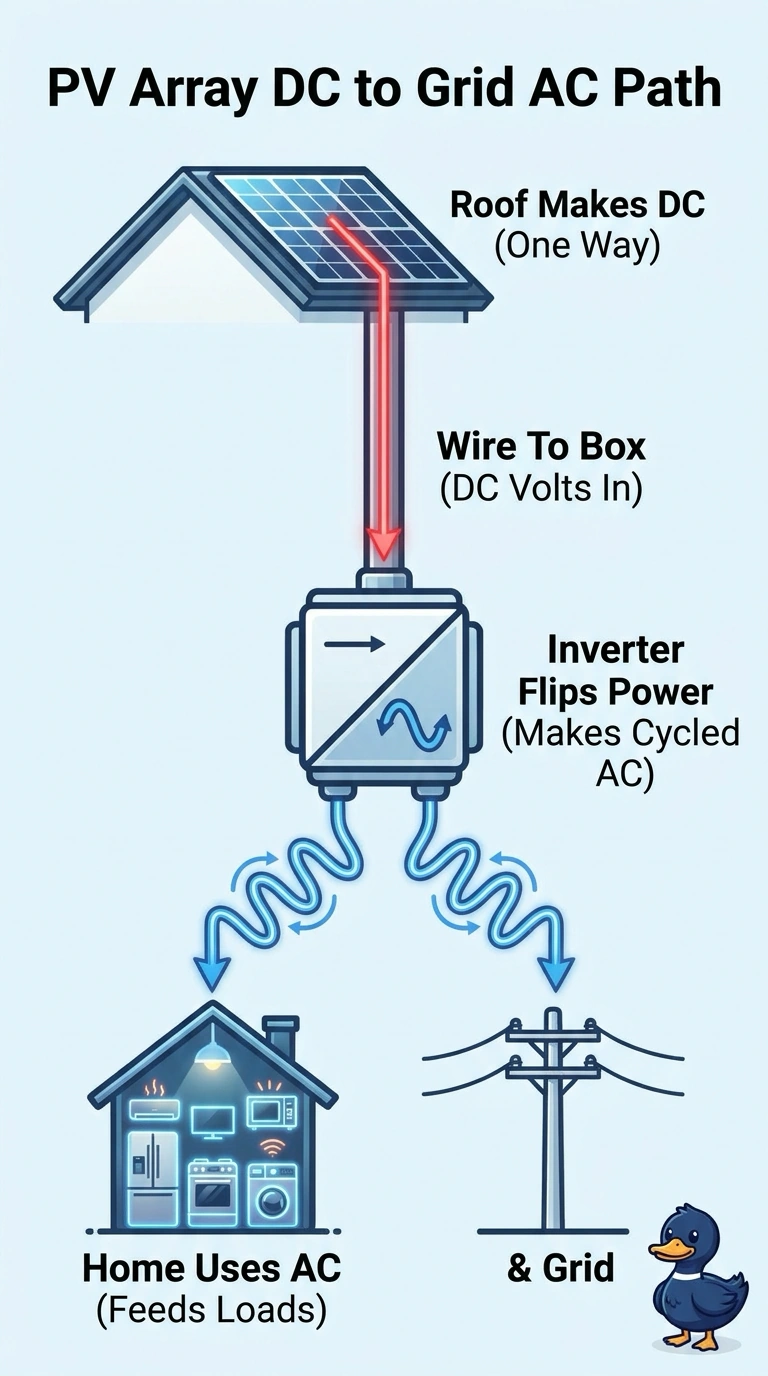
You can trace power from roof to fridge when you track direction first. DC is a one-way street from panels, and AC is the back-and-forth tide shaped by inversion for house use.
Full Explanation
Photovoltaic cells produce direct current that flows in one direction with fixed polarity, whose voltage and current vary with irradiance and temperature, and a grid-tied inverter converts that DC into alternating current whose polarity and direction reverse at system frequency so it can serve household loads and interconnect with the grid through transformers and breakers. Reversing the sources misplaces where inversion happens and misunderstands polarity, since the array cannot directly produce cycling AC and the grid cannot accept raw DC without conversion. Claiming AC holds steady with no cycles confuses AC with DC behavior and misses frequency, phase, and transformer action that define AC distribution and metering. Claiming both reverse and need no inversion erases the core power-electronics step that enables maximum power tracking on the DC side and synchronization on the AC side; an exam caveat is to link waveform to equipment, and a practical check is to read inverter screens that list DC input volts and amps beside AC output volts, amps, and frequency.