
A developer compares options for a 600-kW open-field plant on one flat site with uniform sun, three-phase service, and a central electrical room for easy service access. Which inverter comparison correctly matches string, micro, multimode, and central inverters to this project?
Select an answer to reveal the explanation.
Short Explanation
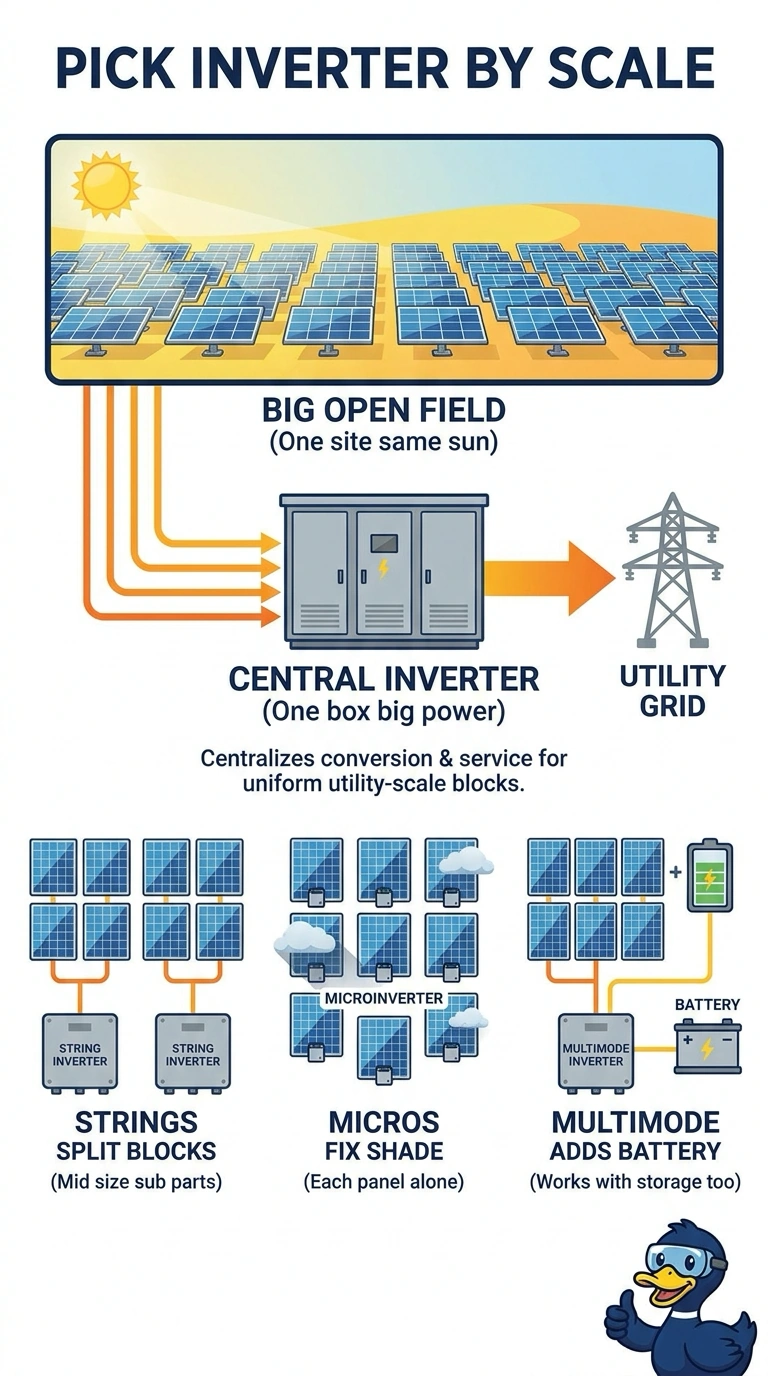
You match the gear to the size of the job. A big open block with same sun favors one strong hub instead of hundreds of small converters.
Full Explanation
A central inverter is the strongest match for this 600-kW open-field plant: a large three-phase unit consolidates conversion for a utility-scale block, and locating it in the central electrical room supports the stated preference for easy service access. Three-phase string inverters are a legitimate modular approach at this scale, offering distributed conversion, MPPT flexibility, and redundancy; however, placing units in field blocks conflicts with the specific advantage of having service access centralized in the electrical room. Microinverters provide genuine module-level conversion, monitoring, and fault isolation, but their fine-grained MPPT is of limited value when sunlight is uniform across the array; the scenario gives no mismatch or shading condition that calls for that feature. Multimode inverters can serve grid-connected systems with battery charging and islanded backup, but those functions add storage-oriented capability that the project does not call for, rather than matching its stated utility-scale conversion and service priorities. Exam caveat: string and central architectures can both be appropriate for large plants, so the best match depends on layout, maintainability, and design priorities—not capacity alone. Practical check: confirm the selected inverter’s three-phase rating, grid-interconnection compliance, service clearances, and access route within the electrical room.