
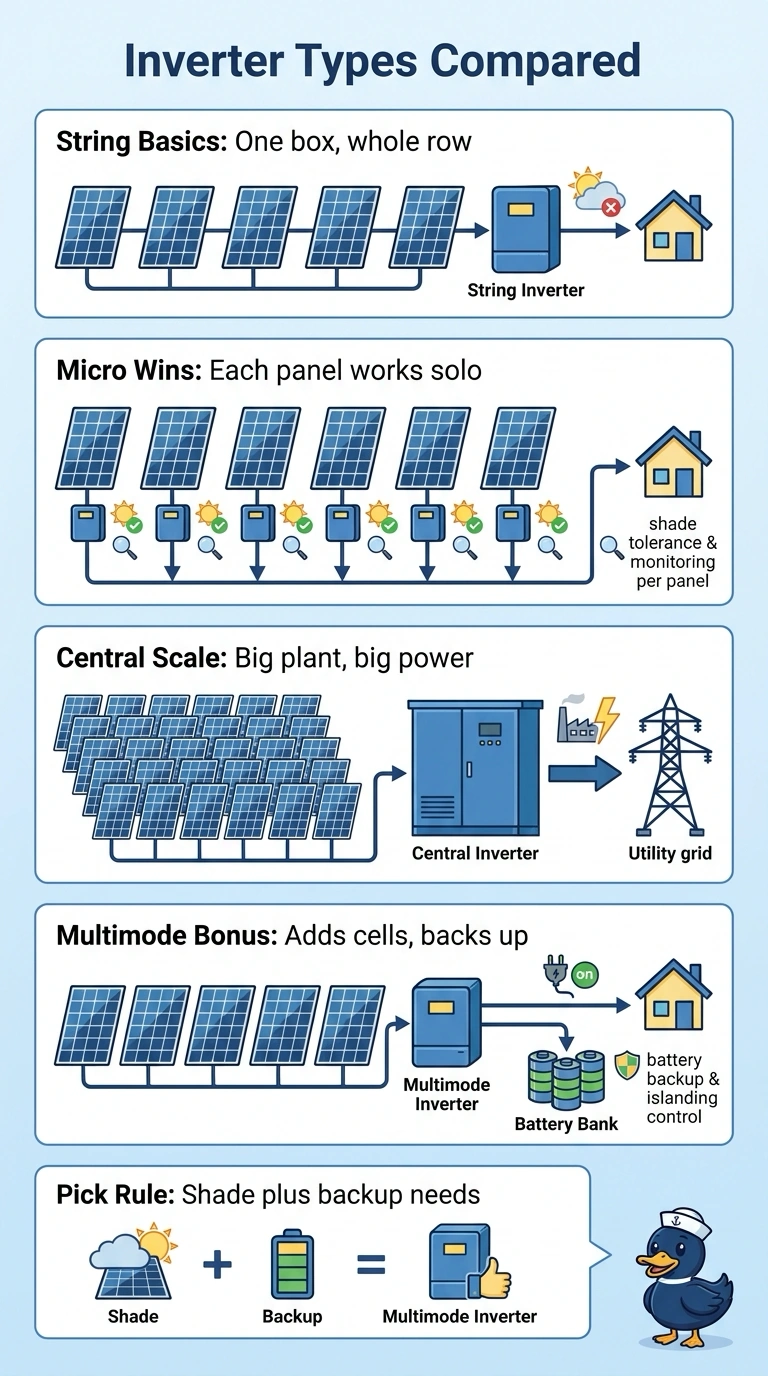
A homeowner has partial chimney shade, wants panel-level monitoring, and may add batteries later for backup. The sales rep offers string, central, micro, and multimode choices. Which inverter comparison should the associate present to match shade tolerance and future battery backup?
Select an answer to reveal the explanation.
Short Explanation
You can match chimney shade with microinverters’ panel-level response and monitoring, then plan for backup with a multimode inverter’s battery and islanding controls. Keep shade tolerance and outage backup distinct: each depends on the equipment designed for that function.
Full Explanation
The comparison that best matches both needs pairs microinverters, which convert power at each panel to help limit the effect of partial chimney shade and provide panel-level monitoring, with a multimode inverter, which manages battery charging and can form an islanded supply for backup when the grid fails. A standard grid-tied system with microinverters can address shade and panel-level monitoring, but it shuts down during an outage and does not provide backup on its own; storage needs suitable islanding equipment. A multi-MPPT hybrid string inverter can accommodate partial shade and future batteries, but its monitoring is usually at the string level rather than panel by panel, so it does not meet the monitoring request. A central hybrid inverter with module optimizers can provide panel-level data and battery backup, but its shared central conversion stage generally responds less independently to uneven shade than microinverters. Exam caveat: “battery-ready” does not by itself mean an inverter can operate safely during a blackout; backup requires compatible islanding controls and appropriate storage. Practical check: confirm monitoring granularity, shade-management design, battery compatibility, and backup loads in the equipment specifications.