
A designer is reviewing cut sheets for a 9-kW home bid using listed modules, a listed string inverter, and listed racking on a city permit that requires third-party safety proof. One vendor offers cheaper gear marked CE only with no NRTL mark. Which equipment specification choice confirms NRTL listing and product safety standards?
Select an answer to reveal the explanation.
Short Explanation
You prove safety with a fresh stamp from a known lab, not a promise. An NRTL mark shows UL safety tests were passed, like a helmet sticker from a real crash lab.
Full Explanation
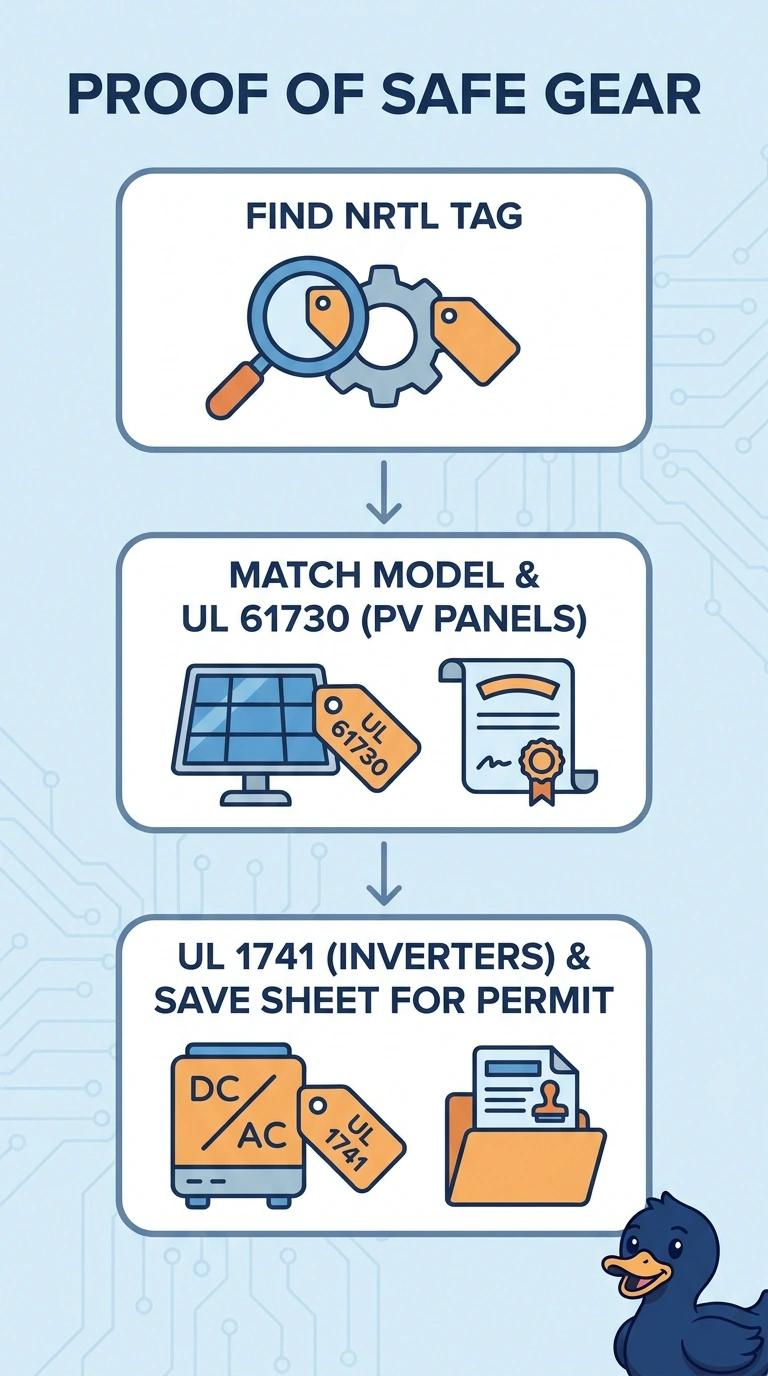
The city permit requires third-party safety proof, which in the US means listing by a Nationally Recognized Testing Laboratory to the correct product standard, so gear bearing an NRTL mark with test to UL 61730 for modules and UL 1741 for inverters directly confirms listed modules and a listed string inverter for the 9-kW home system. The swapped-standards choice fails because standards are not interchangeable: UL 61730 covers module construction and fire safety while UL 1741 covers inverter shock, islanding and grid-interactive safety, so reversing them misstates what was evaluated despite a real NRTL mark. The split-acceptance choice fails because every power component must be listed: NRTL-listed racking to UL 2703 and inverters to UL 1741 cannot cure CE-only modules, since CE is a European market declaration, not NEC-acceptable third-party listing. The component-recognition choice fails because recognized parts are intended for factory use inside a listed end product, whereas field-installed modules and inverters must themselves be listed as complete products. As an exam caveat, do not confuse ISO 9001 quality management, IEEE installation guidance, or utility interconnection approval with safety listing, as none proves NRTL testing. As a practical check, match the NRTL name, file number, model and standard on the label and cut sheet to the online listing directory before approving the bid.