
You are the O&M tech at a 200-kW rooftop site where an inverter cooling fan has seized after six years, and the spare kit is on site. The disconnects for AC and DC are locked only by you, and the site log requires service dates for wear parts. Which lockout/tagout and service-life replacement procedure should the technician follow for the fan assembly?
Select an answer to reveal the explanation.
Short Explanation
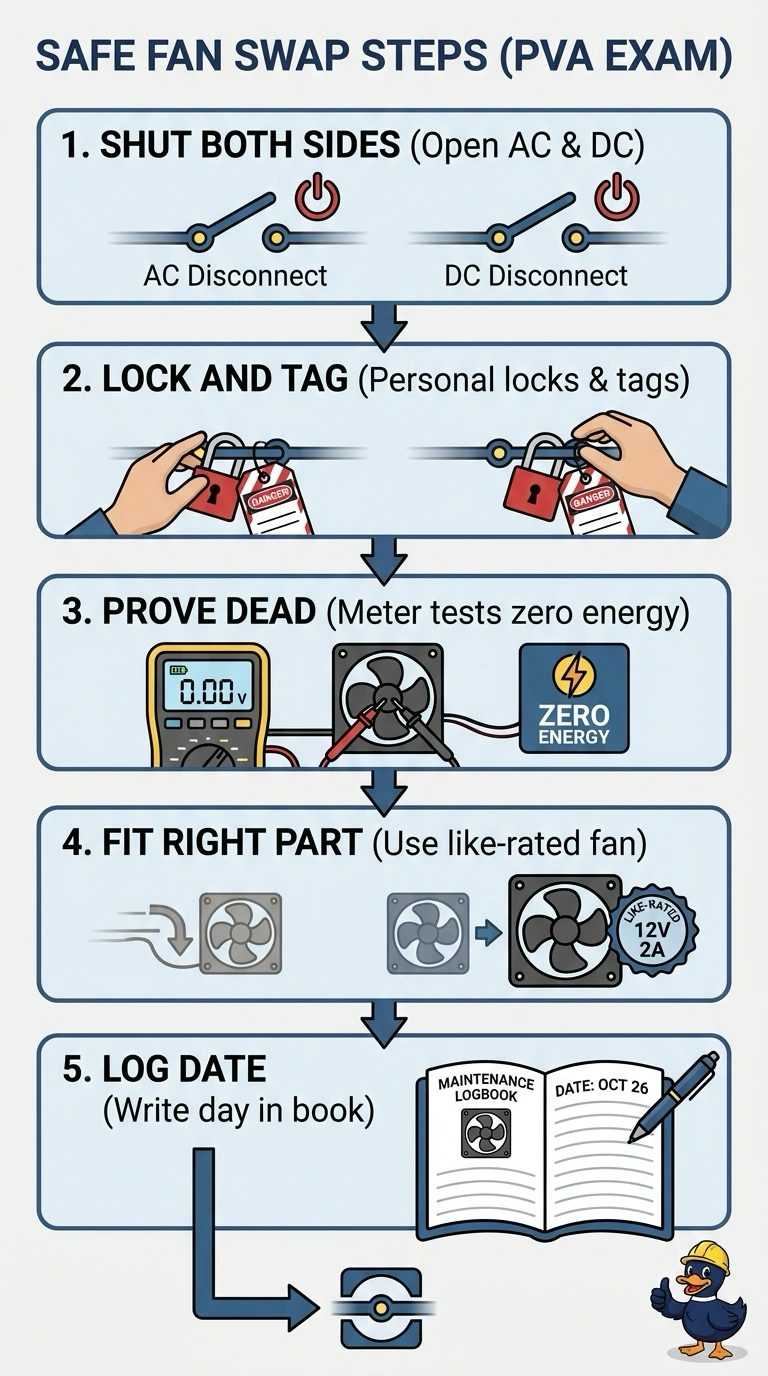
You nailed the safe order when you isolate, lock, and prove dead before you touch parts. Swapping in a like-rated fan and logging it is like resetting an oil-change sticker for the next tech.
Full Explanation
Correct practice requires full isolation of all energy sources, application of personal locks and tags, verification of absence of voltage with a rated meter, replacement with a manufacturer-approved like-rated part, and documentation of the service date to track service life for preventive maintenance. Testing for zero energy after locking fails the core lockout/tagout proof step, leaving stored DC or backfed AC as a shock hazard even when the handles look open. Installing a higher-speed or higher-flow fan violates service-life awareness and listing compatibility because altered airflow, current draw, and vibration can void warranty and shorten inverter life despite seeming like an upgrade. Skipping the log entry meets the electrical safety steps but breaks service-life management, since the next crew cannot plan the next fan, filter, or capacitor change without an accurate age baseline, which drives repeat failures and is a frequent exam trap between safe work and asset records; always confirm your meter on a known source before and after the test and check the manual for the rated spare part number.