
A two-person O&M crew is checking a 12-kW roof array that reads low at midday with no tripped breakers, clean sky, and a south tilt of 28 degrees. The lead asks for a plane-of-array sun check to compare output to expected watts. Which irradiance meter technique should the crew use to verify expected array output?
Select an answer to reveal the explanation.
Short Explanation
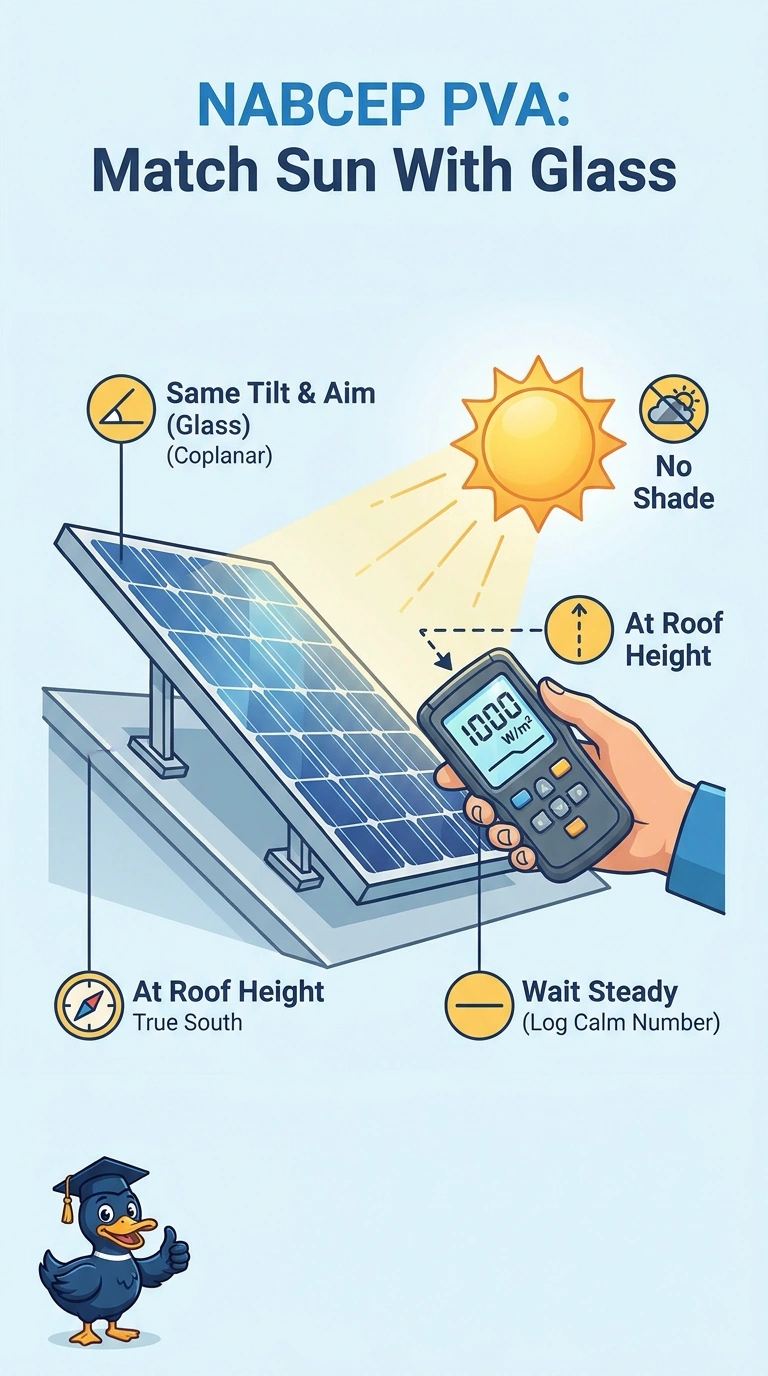
You get fair numbers only when your eye sees the same sun as the glass. Keeping the sensor coplanar in full sun ties your watt math to what the array truly feels, like matching slope on skis.
Full Explanation
The correct technique works because expected power must be calculated from plane-of-array irradiance in the same tilt, azimuth, sun and thermal environment as the modules, so a sensor held coplanar to the 28-degree south plane in unobstructed sun at roof height and allowed to stabilize measures the actual light driving the low midday output under the stated clean sky. The horizontal technique fails by geometry because leveling to the horizon measures global horizontal irradiance, a valid resource-survey quantity that underreads a tilted south array near noon and cannot be multiplied directly into expected watts without transposition. The ground-level inverter technique fails by representativeness because grade light, parapet and dormer shading, roof reflections and different cell temperature mean a convenient lower reading does not equal roof-plane conditions at the modules. The fast peak-surge technique fails by stability because capturing a transient cloud-edge or meter-ranging spike overstates sustained irradiance and inflates expected watts, hiding real soiling, mismatch or degradation. The exam caveat is to match orientation, location and dwell time to the requested plane-of-array verification rather than choosing any otherwise legitimate survey method. The practical check is to clean and shade-check the sensor, confirm tilt with an inclinometer, keep bodies and tools clear, wait tens of seconds for a steady value, then log irradiance, module temperature, time and inverter power together.