
A proposal for a 15-kW rooftop system promises 22 MWh per year, yet the site has high summer heat, long wire runs, dusty air, and a shaded parapet, and the client asks why modeled output is lower. Which derating and system-loss explanation should the designer give to justify the adjusted yield?
Select an answer to reveal the explanation.
Short Explanation
You are turning a lab-perfect number into rooftop reality without hand-waving. Show the chain of small losses that multiply, and the lower yield makes sense.
Full Explanation
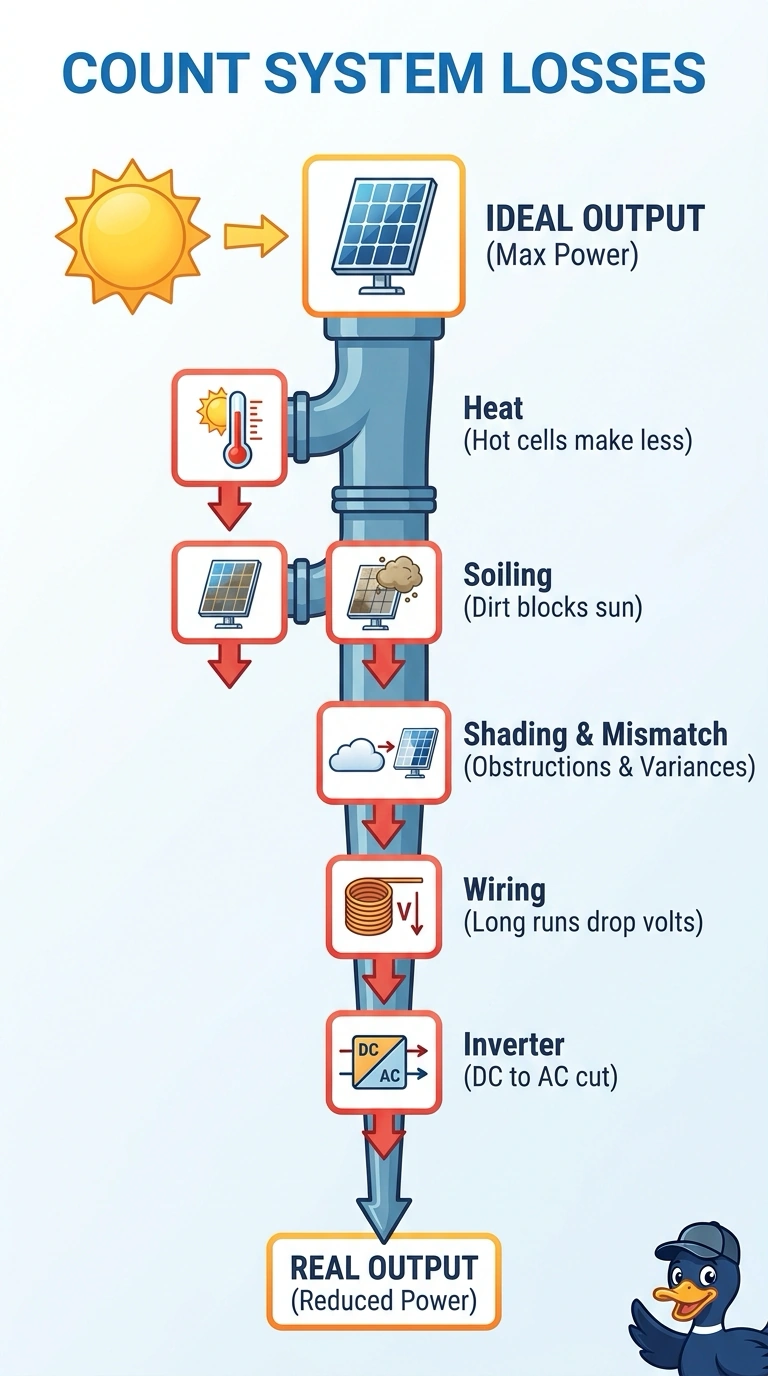
The correct explanation accounts for the main mechanisms that reduce real AC energy below an ideal nameplate-based estimate: elevated cell temperature lowers module power, dust reduces light reaching the modules, parapet shade can reduce output, wire resistance causes voltage drop, mismatch reduces array performance, and inverter conversion is not lossless. These effects should be represented using site conditions and equipment data, rather than assuming the advertised annual energy is guaranteed. Treating parapet shade as negligible fails because the scenario explicitly identifies a shaded area, and shade can cause disproportionate losses depending on string layout and bypass-diode behavior. Assuming the long wire runs have no loss ignores resistive voltage drop, which depends on conductor size, current, and distance. Treating inverter conversion as lossless omits a normal system loss; inverter efficiency varies with operating conditions and loading. A key exam caveat is that losses should not automatically be added as simple percentages: some interact, and shading in particular may be nonlinear, so modeling assumptions matter. As a practical check, confirm the shade profile and array layout, module temperature coefficients, soiling assumptions, conductor lengths and gauges, mismatch assumptions, and inverter efficiency curve in the yield model, then compare the resulting annual estimate with the proposal’s stated energy.