
You are wiring a 13-kW rooftop-to-attic run where metal conduit passes through a sharp panel enclosure knockout, joins to a second conduit length outdoors, and enters a junction box that needs a watertight cable pass for the monitoring line in a rainy climate. Which choice of fittings with connectors, couplings, bushings, and strain reliefs best protects the conductors?
Select an answer to reveal the explanation.
Short Explanation
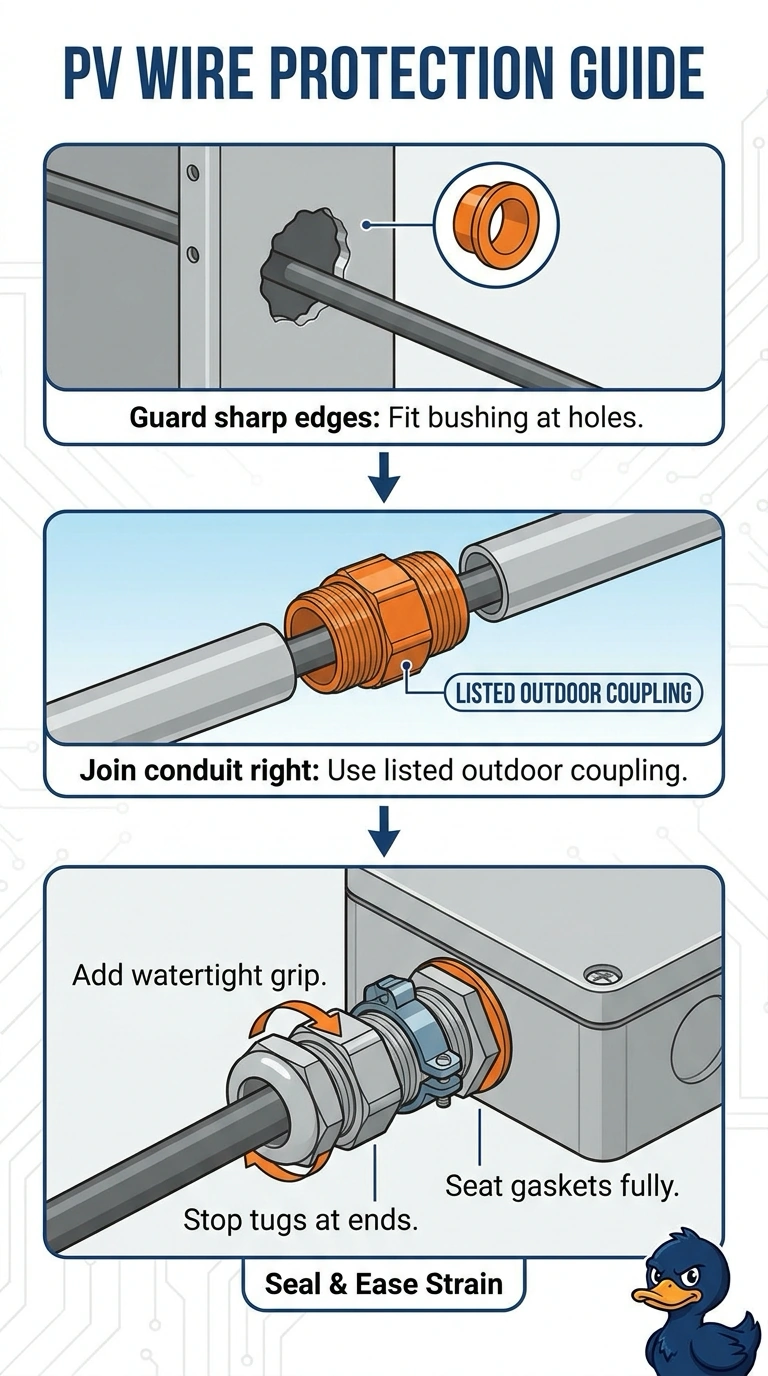
You're giving every wire a smooth, dry, tug-proof path through metal and weather. Those listed fittings stop cuts, leaks, and strain where damage starts.
Full Explanation
The correct choice addresses all three exposure points: a bushing shields insulation from the sharp knockout, a coupling listed for the outdoor location joins the conduit lengths appropriately, and a sealed strain relief both supports the monitoring cable and limits water entry at the junction box. A deburred knockout can remove burrs, but it does not provide the specified insulating bushing; a remaining edge or later damage can still abrade conductor insulation. An indoor-rated coupling may be suitable in a dry interior installation, but it is not a suitable substitute for a fitting listed for the exterior exposure and can compromise the conduit joint in rain. A nonsealed cord grip can secure a cable mechanically, yet it does not make the entry watertight, leaving the stated moisture hazard unaddressed. Exam caveat: the required listing and environmental rating depend on the conduit type, enclosure, and applicable electrical code, so do not assume that a fitting suitable for one raceway system is interchangeable with another. Practical check: verify each fitting’s markings and installation instructions, confirm the bushing covers the sharp edge, and inspect the completed cable entry for a secure grip and intact seal.