
You are assigned to drill rail lags in a hot attic, then help torque DC combiner terminations on a live 400-V rooftop disconnect nearby. The lead warns of dust, sharp flashing, loud tools, and arc-flash risk. Which PPE selection should you make for the task?
Select an answer to reveal the explanation.
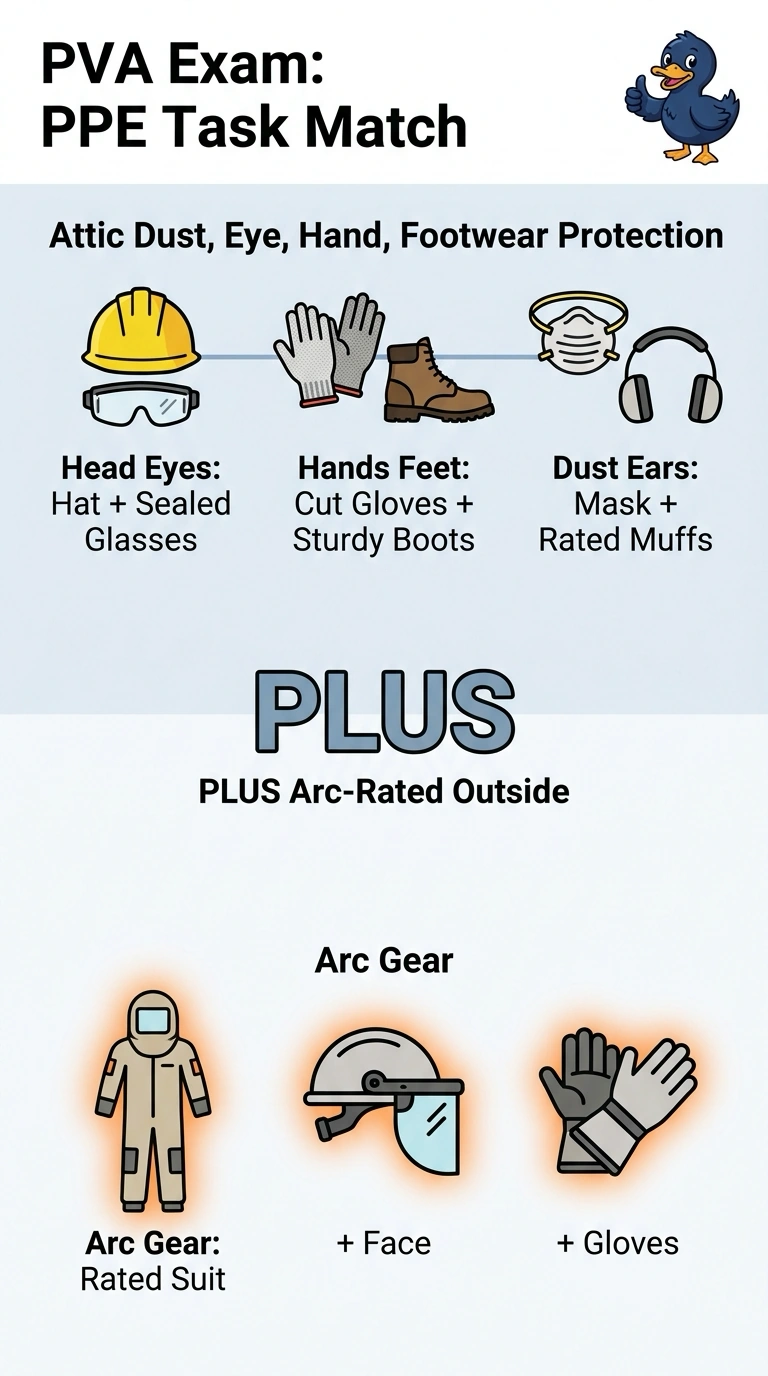
Short Explanation
You need dust, eye, hand, and footwear protection for attic drilling, then arc-rated face and hearing protection for the live disconnect. Swap layers as you move, and never downgrade live-work protection. Let task-based PPE match each hazard.
Full Explanation
The correct selection matches the hazards in each work area: dust, eye injury, cuts, and foot injury during attic drilling, plus arc-rated face protection and hearing protection for the live disconnect work. Safety glasses, cut-resistant gloves, boots, and arc-rated face and hearing protection cover the eye, hand, foot, arc-flash, and noise hazards, but leave you without dust protection for attic drilling. A dust respirator, safety glasses, cut-resistant gloves, boots, and an arc-rated face shield cover the attic hazards and arc-flash risk, but relying on distance from noisy tools does not provide hearing protection. A dust respirator, safety glasses, cut-resistant gloves, boots, earmuffs, and a standard face shield cover dust, eye, hand, foot, and noise hazards, but a standard face shield is not arc-rated and cannot substitute for protection selected for the arc-flash hazard. A common exam caveat is that PPE selection does not by itself authorize energized work; required procedures, qualifications, and controls still apply. Before work, check the disconnect’s arc-flash label and applicable assessment to confirm the required PPE rating and boundaries, and verify the selected equipment is suitable and in serviceable condition.