
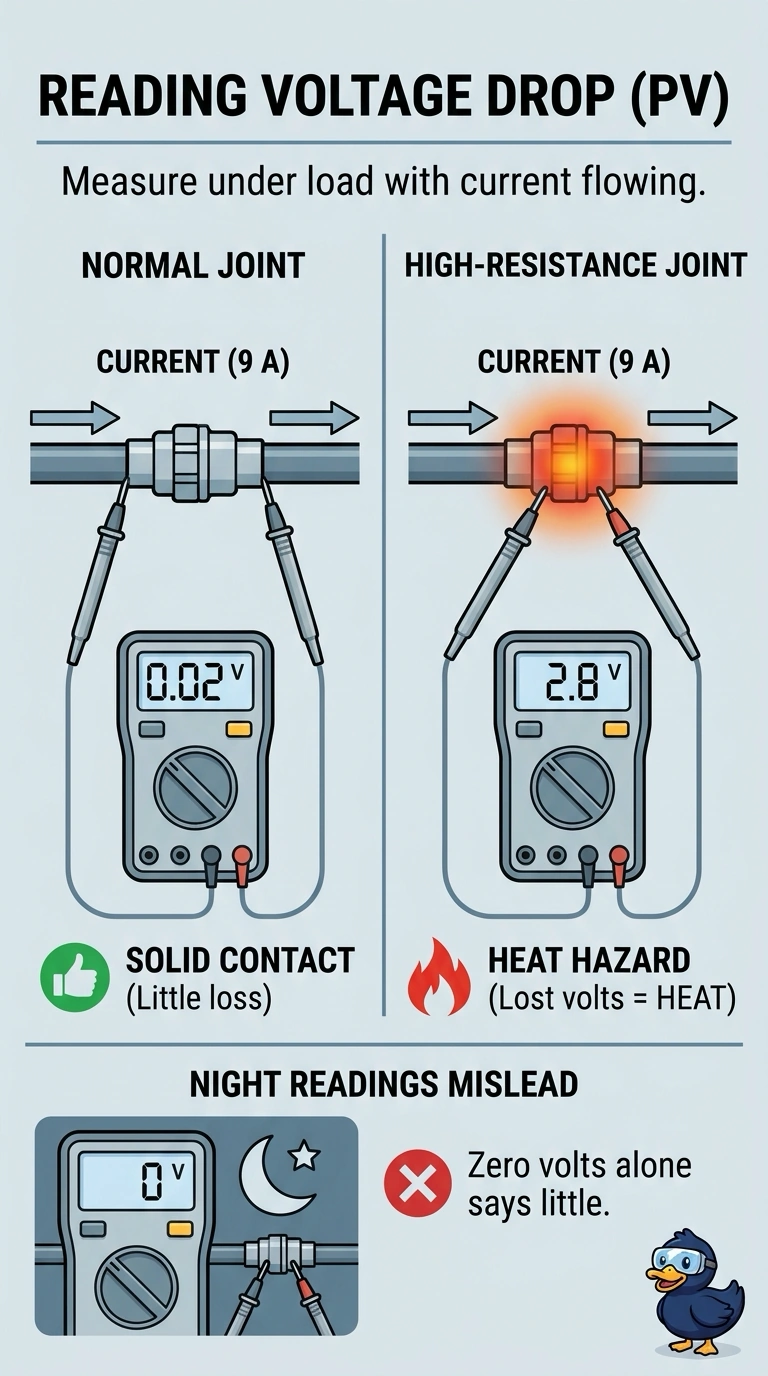
An apprentice checks two identical inline fuse holders on a DC string carrying 9 A at midday: across one the meter reads 0.02 V and across the other 2.8 V, while both points read 0 V after sunset when the array produces nothing. Which interpretation of these voltage-drop readings is best supported?
Select an answer to reveal the explanation.
Short Explanation
A meter only shows a difference in voltage, so with no current flowing there's nothing to drop across a good joint. At 9 A, that 2.8 V turns into heat inside the connector, which is how melted fuse holders start. You get the honest story from voltage drop under load, because it shows what the load actually sees.
Full Explanation
Voltage drop under load is a direct read on resistance because Ohm's law ties them together: with the same 9 A flowing through both fuse holders, the one showing 2.8 V has far more resistance than the one showing 0.02 V, and that extra resistance is turning roughly 25 watts into heat inside the connector. That heat is what discolors and eventually melts a fuse holder, so the reading points straight at the joint to service. Reading zero after sunset fails as evidence because with no current there is no drop to measure, which makes a good joint and a bad joint look identical on a dead string. Calling the smaller reading the worse one reverses the relationship between voltage and resistance, since a fixed current produces a larger drop only across the larger resistance. Blaming string voltage division fails because a fuse holder is a near-short in series with the modules, so the source voltage appears across the modules rather than across the holder. A caveat for the exam is that an idle string can show induced or ghost voltage, so confirm any suspicious reading with the circuit loaded. In practice, measure across the suspect device while current flows and compare the result with the manufacturer's limit.