
A technician measures a residential string at midday and reads 410 V open-circuit as expected, but voltage sags sharply when loaded and one connector feels warm. Resistance across that section reads high. Which interpretation of voltage, current, resistance and impedance measurements best explains the readings?
Select an answer to reveal the explanation.
Short Explanation
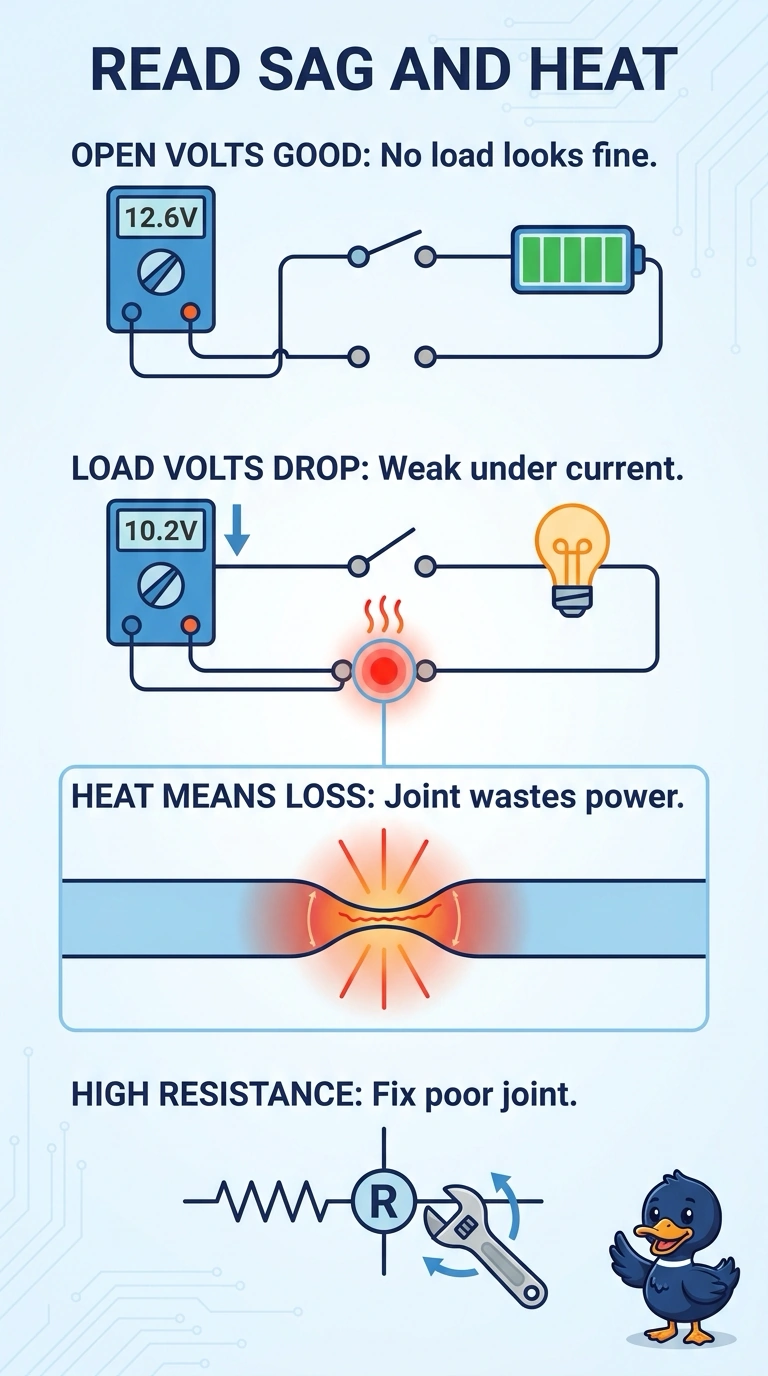
Your 410 V reading with no load looks normal, but the sharp voltage sag under load points to a poor connection. Like a kinked hose, high resistance at the connector restricts current and creates heat.
Full Explanation
The correct interpretation is a high-resistance series connection. With little or no current flowing, the string can show its expected open-circuit voltage; under load, the resistance produces a voltage drop and dissipates power as heat. The high resistance measured across the affected section and the warm connector localize the problem to that connection. An undersized or excessively long homerun can cause load-dependent voltage drop and conductor heating, but it does not account for the measured resistance being localized at the connector. A module with elevated internal series resistance can also pass an open-circuit voltage check and sag under load, but its resistance would be within the module, not at the warm connector. A conducting bypass diode can reduce string voltage under operating conditions while leaving open-circuit voltage near normal, but it does not explain the high-resistance reading and connector heating at the measured section. Exam caveat: open-circuit voltage alone does not establish that a string can deliver normal current; test under suitable load and irradiance. Practical check: de-energize and follow PV safety procedures, then inspect and verify the connector and its terminations, and compare voltage drop across the connection under load with manufacturer limits.