
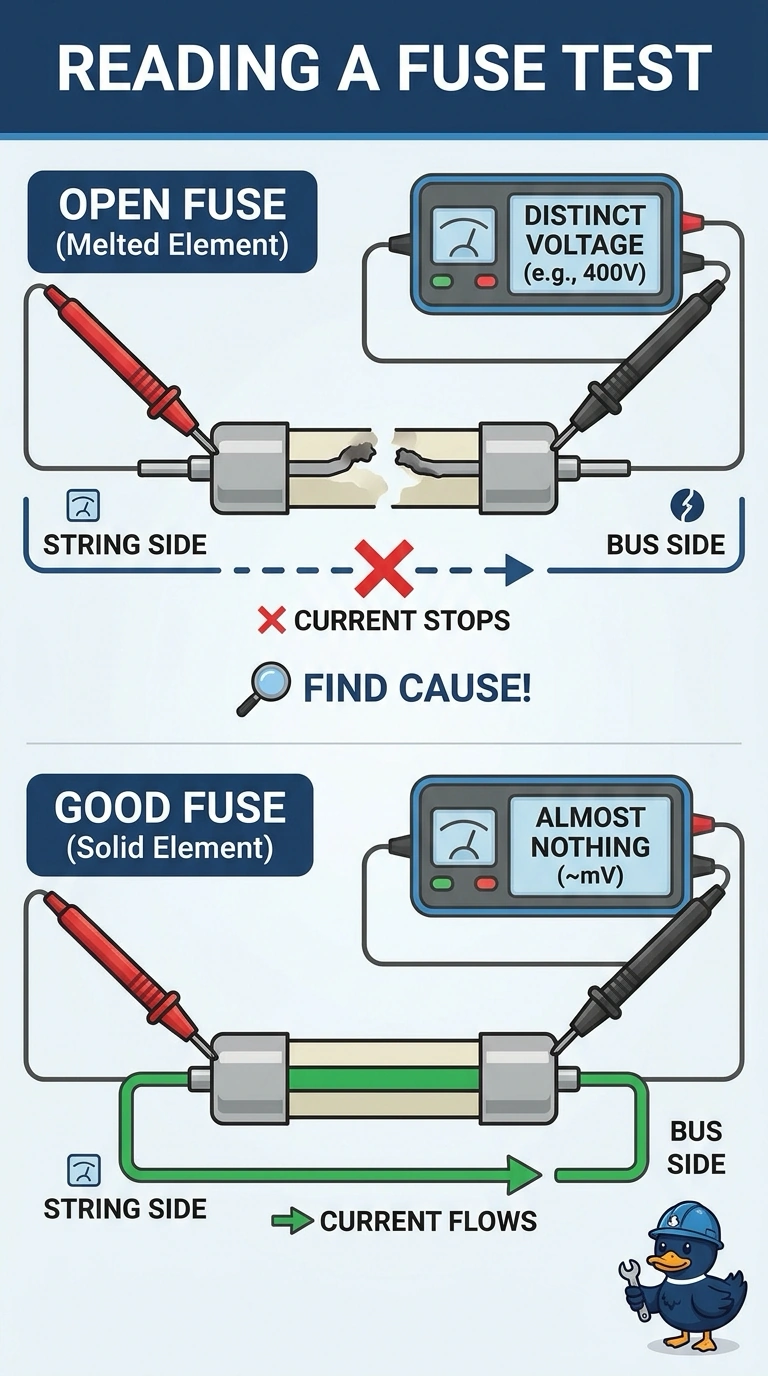
During a rooftop O&M visit, one string in a 24-module array reports zero current at the combiner while its neighbors read normal. The array is in full sun with the DC disconnect closed, and a meter across that string's inline fuse reads a distinct voltage while the same test across a healthy fuse reads almost nothing. Which fault do the readings pinpoint at that fuse?
Select an answer to reveal the explanation.
Short Explanation
That distinct voltage across the fuse points to an open fuse path, likely caused by a melted element, so your string can’t send current to the combiner. A healthy fuse is like a clear doorway for current, with almost no voltage difference from one side to the other.
Full Explanation
A distinct voltage across the fuse path, together with zero string current, is consistent with an open fuse: the string side and bus side can sit at different potentials, and the high-impedance meter measures that difference. A conducting fuse normally has a small voltage drop. The reading does not by itself prove that the fuse element melted; a poor connection at the fuse or its holder can also interrupt the path, so inspect and test the fuse and holder safely. A loose bus-side lug or an open conductor upstream of an intact fuse would not ordinarily create a voltage drop across the fuse element itself. Shading may reduce a string's current, but the stated full-sun conditions and voltage across the fuse point instead to an interruption at the fuse path.