
A technician opens a rooftop DC combiner at 2 p.m. to reset a tripped breaker. The string circuits run to a central inverter in fault mode with its AC disconnect open, while the utility still feeds the building. Which statement correctly describes the hazard at the combiner?
Select an answer to reveal the explanation.
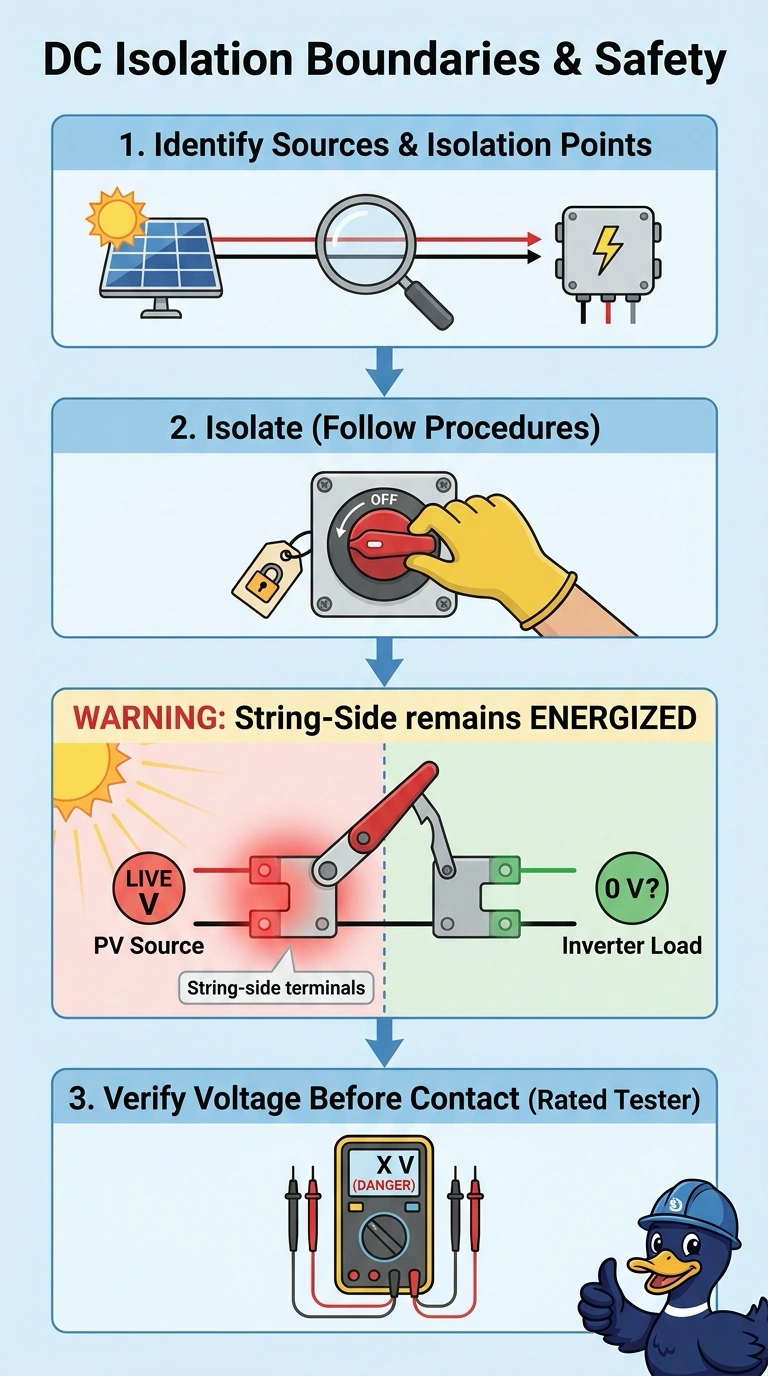
Short Explanation
Your string-side terminals may stay energized in daylight, even if the inverter is faulted and its AC disconnect is open—like a battery that keeps supplying power when another switch is off. Before you touch anything, identify the isolation boundary and verify voltage with an appropriate tester.
Full Explanation
The correct statement recognizes that photovoltaic modules produce DC whenever illuminated, so at 2 p.m. the string-side conductors can remain live even though the inverter is in fault mode and its AC disconnect is open. The AC disconnect separates the inverter from the utility on the AC side; it does not remove the modules’ source of DC at the combiner. Before contact, the technician must determine which conductors and terminals are actually isolated, follow the applicable isolation procedure, and verify voltage with an appropriately rated tester. Locking out the inverter’s DC input and checking the inverter side is a sound isolation practice for work on that side, but it does not establish that the combiner’s string-side terminals are dead; the proposed test is at the wrong boundary. Deferring work until sunset can reduce module output, and isolation plus testing remains prudent, but it does not answer the hazard during the stated daytime task or justify assuming zero voltage. Locking out the utility supply and checking the combiner is sensible when addressing an AC backfeed concern, but it leaves the daylight PV source untouched. Exam caveat: an open disconnect, a dark indicator, or a fault display alone is not proof of absence of voltage. Practical check: identify the specific conductors on both sides of the relevant disconnects and use a properly rated meter, tested before and after measurement, to confirm their voltage state.