
A homeowner wants a 10-kWh-class wall battery for evening lights, fridge, and internet through short outages, AC-coupled to an existing 6-kW inverter on a 200-A panel. Which evaluation should the associate perform to compare storage system specs?
Select an answer to reveal the explanation.
Short Explanation
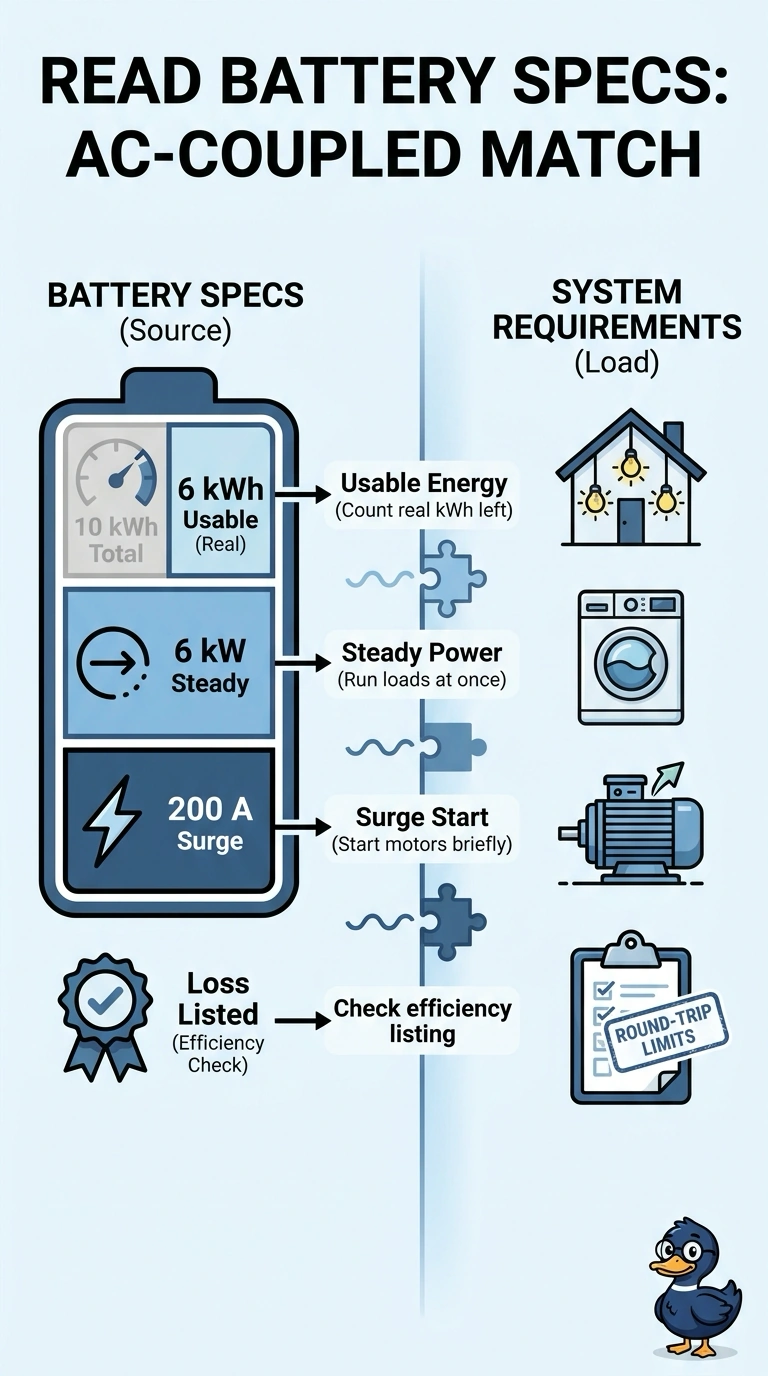
Labels can flatter, but evenings run on what you can truly pull. Usable energy and steady power tell your real story. Check usable specs against your night loads first.
Full Explanation
The correct evaluation is right because a 10-kWh-class wall battery for lights, fridge, and internet must be judged on usable energy after discharge limits rather than nameplate, on continuous AC power to carry combined evening loads through an AC-coupled path, on surge capability to start the refrigerator compressor without tripping, on round-trip efficiency that reduces overnight autonomy especially with double conversion, and on safety listing and compatibility for connection to a 200-A panel with an existing 6-kW inverter. The review that compares usable energy and continuous output with efficiency and listing for AC-coupled use is sound for steady loads but fails on surge concept because it assumes average power covers starting current and risks shutdown on compressor inrush during a short outage. The review that matches usable energy, continuous power, and surge for night loads while omitting round-trip efficiency is sound for capacity and power but fails on energy-conversion concept because AC coupling adds inverter and charger losses that shrink deliverable kWh and can leave an early-morning shortfall for fridge and internet. The review that matches energy, power, and surge with efficiency but omits listing for panel connection is technically strong but fails on code-compliance concept because an unlisted or mismatched interconnection can fail inspection, utility approval, and warranty on a residential service. Exam caveat: always distinguish total nameplate from usable energy and distinguish continuous output from time-limited surge at expected temperature and state of charge. Practical check: pull manufacturer sheets for usable kWh, continuous kW, surge kW with seconds, round-trip efficiency, and listed AC-coupled compatibility, then cross-check with an evening load audit including measured fridge start.