
During O&M training, techs compare a 400-W nameplate to lower midday field output on a warm roof with light wind. The data sheet lists both STC and NOCT ratings. Which comparison of STC and NOCT test conditions best sets expected performance?
Select an answer to reveal the explanation.
Short Explanation
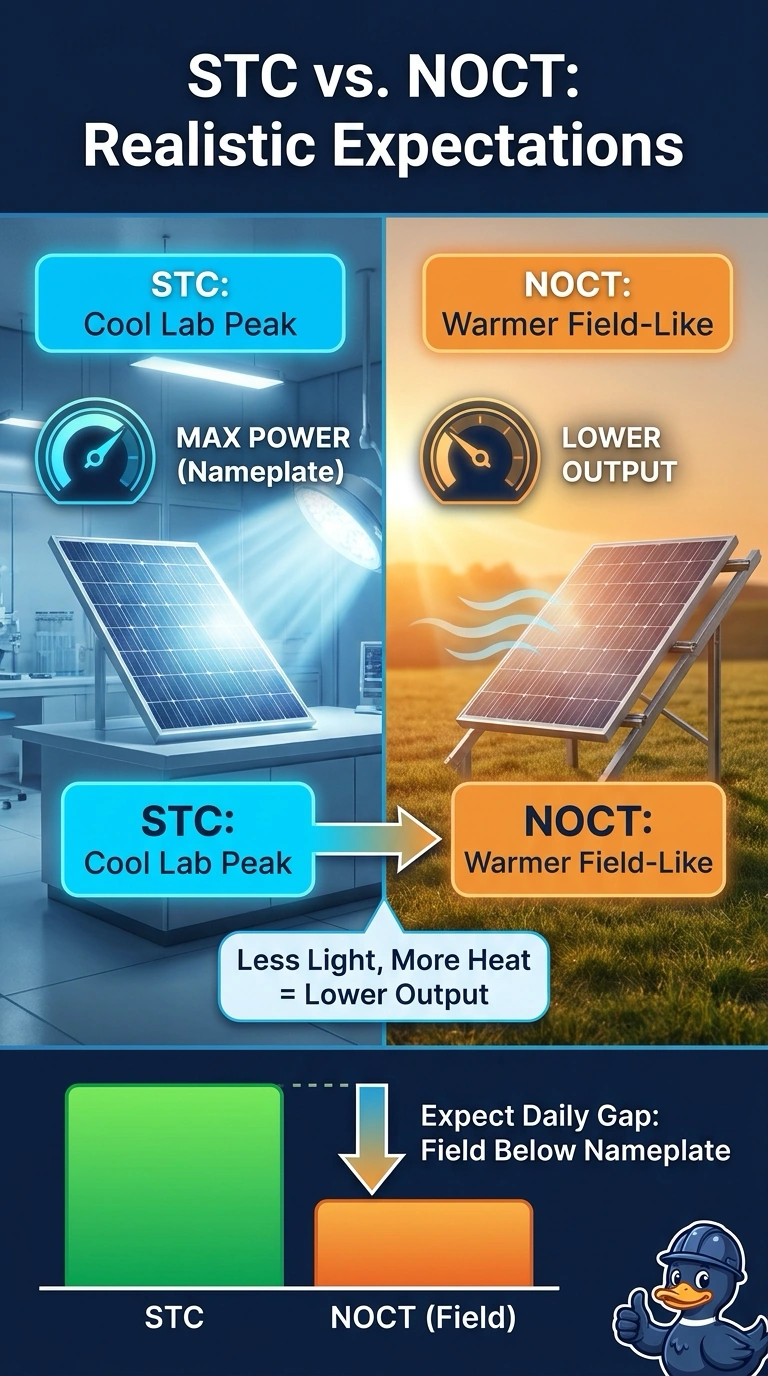
You caught why lab watts run higher than roof watts. Lab tests are like track times with perfect air, and field-like NOCT runs warmer and softer than crisp STC.
Full Explanation
The correct comparison is that STC is a standardized peak-power rating measured at 1,000 W/m² irradiance, an AM1.5 spectrum, and a 25°C cell temperature; NOCT is measured under lower irradiance and warmer, more field-like thermal conditions, including specified ambient temperature and light wind. A warm roof can therefore produce less power than the STC nameplate, and NOCT offers a more realistic reference for expectations, though it is not a prediction for every site. Treating NOCT as if its module temperature were 25°C confuses its elevated operating temperature with the STC temperature and misrepresents the condition that affects output. Adjusting STC expectations for sunlight alone is also incomplete: module temperature matters because crystalline-silicon module power generally falls as cell temperature rises. Assuming still air misstates the NOCT setup, which specifies light wind; wind affects module cooling and thus the temperature relevant to output. Exam caveat: NOCT is a rating under defined test conditions, not a guaranteed field value, and datasheets may use related terms such as NMOT with different procedures. Practical check: compare measured irradiance and module temperature, along with shading, orientation, and inverter limits, against the rating conditions before attributing a midday shortfall to a fault.