
A designer must place a 6-kW fixed array on a low-slope commercial roof in the northern hemisphere with room to face south, southeast or southwest and tilt 5, 20 or 35 degrees while avoiding row shading. Which tilt and azimuth choice maximizes annual energy?
Select an answer to reveal the explanation.
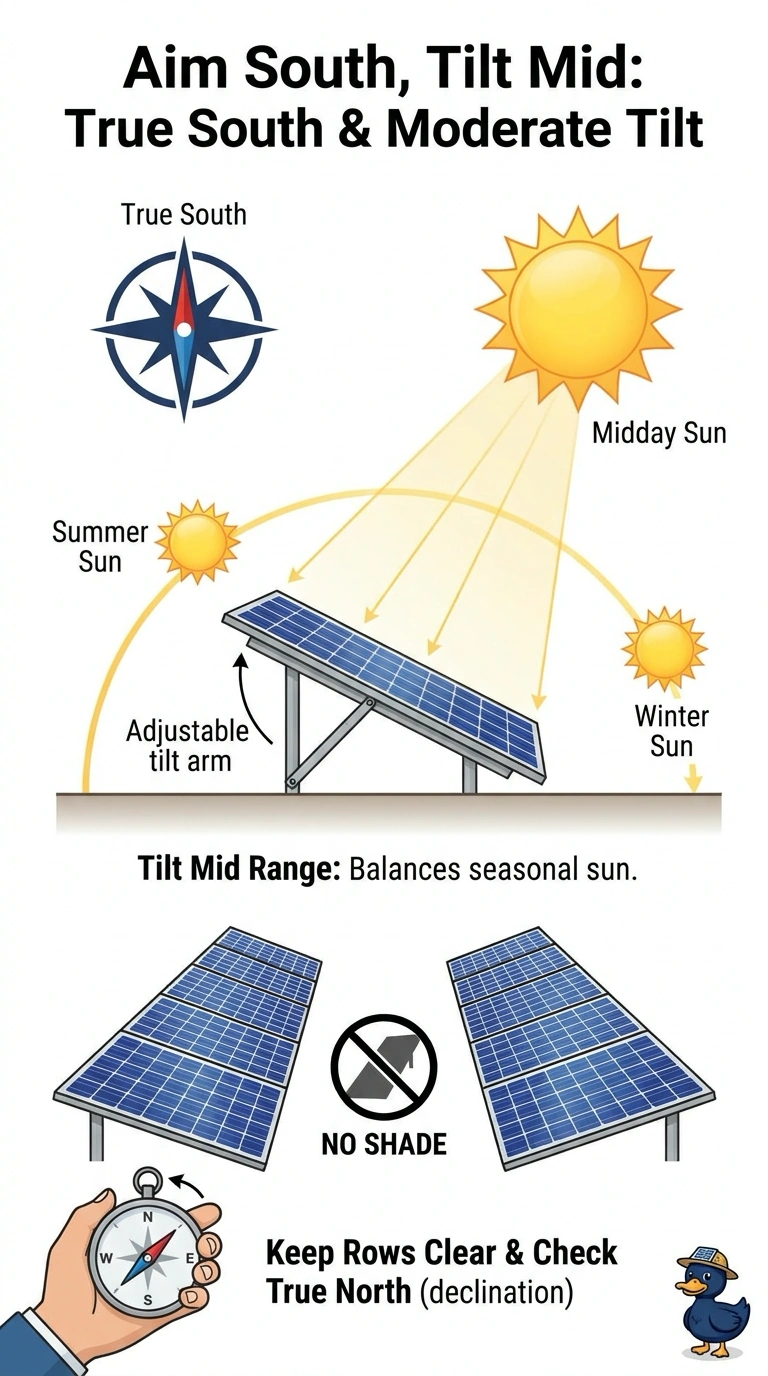
Short Explanation
You’ll capture more energy across the year by balancing the sun’s seasonal path, rather than favoring morning or afternoon. True south at a moderate tilt gives you a better solar window, like angling a chair toward the midday sun.
Full Explanation
For a fixed array in the northern hemisphere, facing true south generally captures the most sunlight over the full day. A moderate tilt of 20° balances seasonal sun angles and typically yields more annual energy than a very shallow or steep tilt. Facing southeast at 20° shifts generation toward morning, which can suit a morning-heavy load but does not maximize total annual generation when load timing is not the objective. Facing southwest at 20° similarly favors afternoon production; it may better match later building demand, but gives up some all-day solar exposure compared with true south. Facing true south at 5° keeps the preferred azimuth and can reduce row-to-row shading or spacing needs, but the shallow angle is less favorable for annual collection than the moderate tilt. Exam caveat: the exact best tilt can vary with latitude and local weather, and a site-specific yield model can refine the general south-and-moderate rule among the stated choices. In practice, verify row spacing against the roof layout and check that parapets, rooftop equipment, and neighboring structures do not shade the modules during productive hours.