
A sales rep quotes a 25-year rooftop system for a home with 18-year-old asphalt shingles and an existing 11-year-old string inverter the owner wants to keep. The customer wants no surprise costs. Which maintenance cost forecast best anticipates equipment and roof replacement costs?
Select an answer to reveal the explanation.
Short Explanation
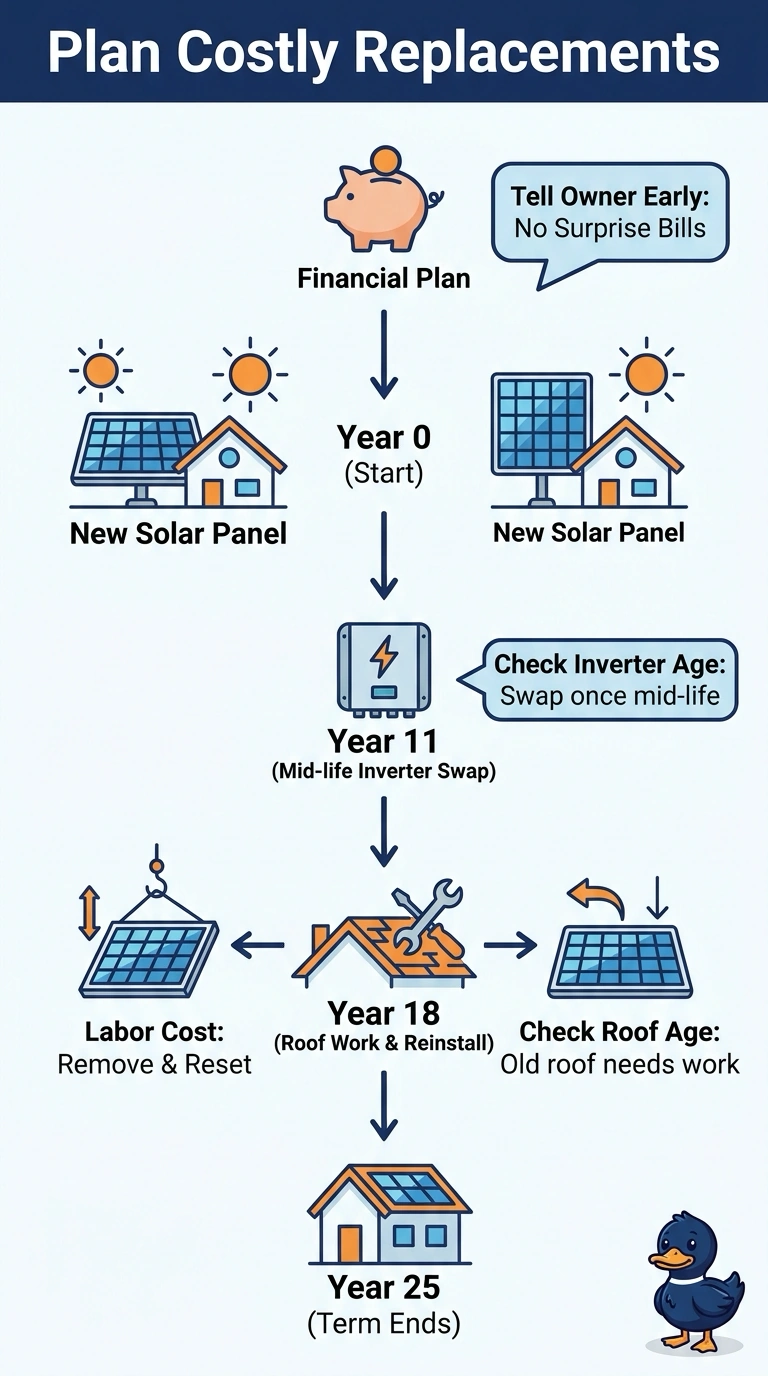
Your panels may outlast both the roof and inverter, much like a car’s tires and battery wear out before the car itself. Budget for a mid-life inverter replacement and roof tear-off with system reinstall before the 25-year term ends—that’s a smart lifecycle forecast.
Full Explanation
The sound forecast includes both major costs likely to arise during the 25-year system term. The existing string inverter is already 11 years old, so planning for a mid-life replacement is prudent; the 18-year-old asphalt roof is also unlikely to last through the system term without replacement. Roof tear-off and system reinstallation can add substantial cost when panels must be removed and reinstalled, so budgeting for that work helps avoid surprises. Budgeting for a mid-life inverter replacement and routine shingle repairs, while leaving the roof in place, allows for inverter costs but treats repairs as a substitute for forecasting likely roof replacement. Planning for roof tear-off and reinstallation while assuming the existing inverter will operate for the full term overlooks the age of that equipment and a likely replacement cost. Replacing the roof before installation and assuming the 11-year-old inverter will last through the full term avoids later roof work but makes the same unrealistic inverter-life assumption. Exam caveat: actual lifespans vary with product quality, climate, installation, and maintenance, so these are planning estimates, not guaranteed failure dates. Practical check: inspect the roof and review the inverter’s model, warranty, service history, and replacement pricing before finalizing the forecast.