
You are mounting aluminum rails to pressure-treated wood blocking on a coastal home with stainless rail hardware and a galvanized flashing kit, within sight of salt spray. Which fastener choice should you specify to meet strength, size, and metal compatibility?
Select an answer to reveal the explanation.
Short Explanation
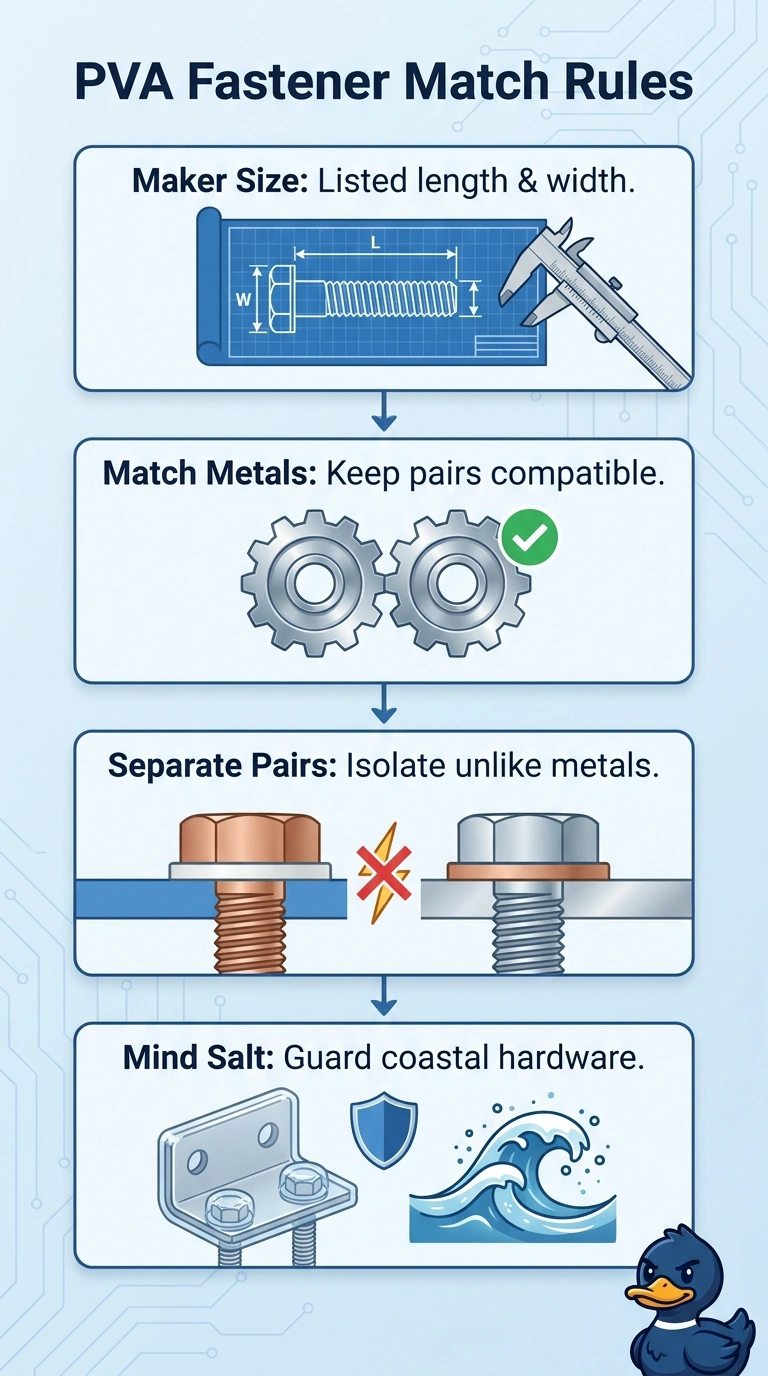
Salt air punishes mixed metals, so build your stack like good neighbors. Right size plus matched metals keeps joints strong for years. Lean on compatibility to beat rust and loosening.
Full Explanation
The correct specification follows the fastener maker’s required size for the rail system while requiring compatible metals and separation where dissimilar metals could form galvanic couples. That matters here because salt spray accelerates corrosion, the rail is aluminum, and the assembly includes stainless hardware, galvanized flashing, and pressure-treated wood. The 304 stainless choice uses the specified size and isolation, but 304 generally offers less resistance to chloride-rich coastal exposure than 316; its weakness is corrosion suitability, not its installation method. The oversized 316 choice has suitable alloy resistance and isolation, but departs from the maker’s required size. A larger fastener is not automatically stronger in the assembly: it can alter clearances, edge distances, or the intended load path, and should not replace the specified size without approval. The hot-dip galvanized choice is a commonly used approach with treated wood, but leaving it in contact with stainless hardware creates a dissimilar-metal interface that can promote galvanic corrosion, particularly in salt spray. Exam caveat: actual compatibility depends on the specific treatment chemistry, coatings, exposure, and manufacturer instructions; do not infer that one metal pairing is universally acceptable. As a practical check, verify the rail and fastener schedule, treatment designation, and flashing details, then confirm the approved fastener alloy and any required isolating washers or sleeves for every metal interface.