
A designer is laying out a 7-kW fixed roof array for a suburban home at 40 degrees north latitude with a low-slope hip roof, light tree shade to the east, and a customer wanting best yearly energy. Which array tilt and azimuth choice should the designer recommend for annual performance?
Select an answer to reveal the explanation.
Short Explanation
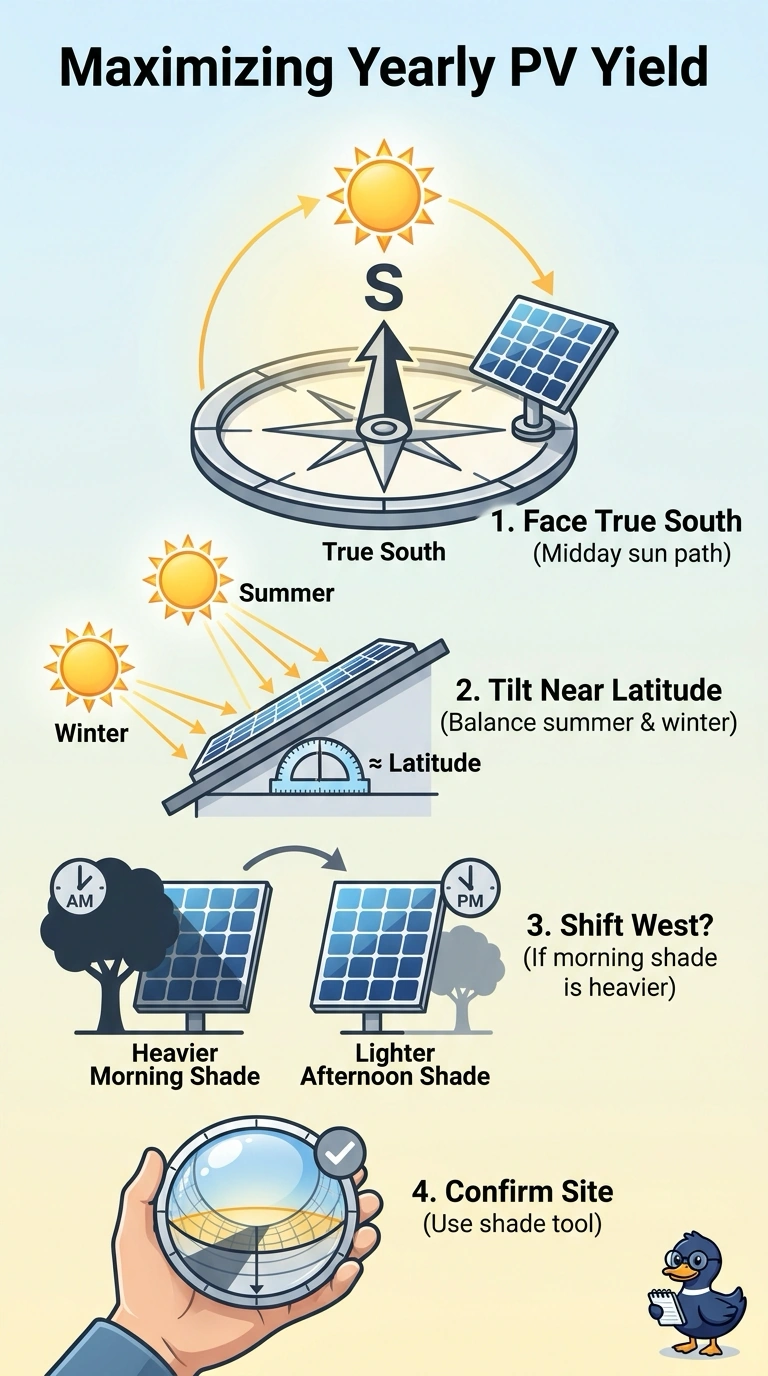
You are aiming the array like a sunflower that cannot move all year. A south-facing tilt near latitude balances sun across seasons for top yearly yield.
Full Explanation
Facing true south with a tilt near the site latitude is a sound starting point for maximizing annual energy at 40° north: it balances exposure across the seasons. Because the stated shade is to the east, shifting the array slightly west can reduce the impact of morning shade and favor later, clearer hours, provided the roof geometry and electrical layout allow it. Keeping the array centered due south is a common baseline, but it fails to account for the specific east-side shade and therefore misses the opportunity to improve production under the stated conditions. Following the hip roof’s low pitch is often a practical choice: it can simplify mounting, reduce wind loading, and avoid unnecessary structural complexity. However, a low-slope roof-following tilt may be substantially below the latitude-near tilt that better supports the stated goal of highest yearly energy. A steeper south-facing tilt is also used when winter output is especially valuable, since it can improve the sun angle during that season. Here, though, the customer wants the best annual yield, not a winter-weighted production profile, so that seasonal tradeoff is not the best match. Exam caveat: latitude tilt is a useful rule of thumb, not an exact universal optimum; local weather, roof limits, and shading can shift the result. Before finalizing the layout, check a site-specific annual-yield model using the actual roof planes, shade profile, and feasible module spacing.