
A new salesperson tells a homeowner with a 400 W module quote that the system will make 6,000 W per day, mixing ratings and bills that show kWh use. The manager asks for a correction before proposals go out. Which statement correctly distinguishes power (W) from energy (Wh)?
Select an answer to reveal the explanation.
Short Explanation
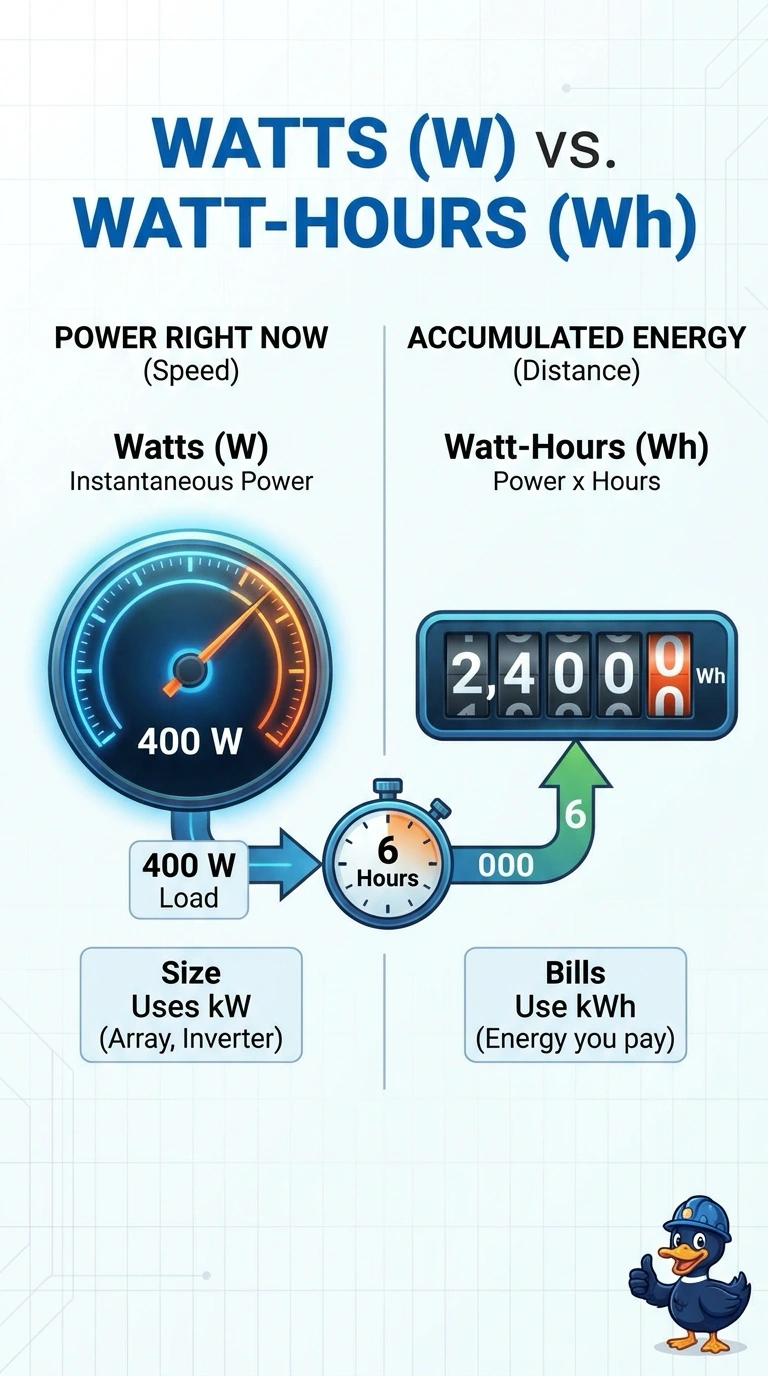
Think of watts as power at a moment and watt-hours as energy accumulated over time. Keeping time in the picture helps you explain customer savings without confusing a module’s rating with the kilowatt-hours on a bill.
Full Explanation
The correct statement distinguishes power, a rate of energy transfer measured in watts, from energy, the amount accumulated over time and measured in watt-hours. A module’s 400 W rating describes its output under specified test conditions; it does not state its daily energy production. Multiplying rated watts by peak-sun hours can help estimate energy, but it does not turn the module’s power rating itself into daily energy. A 6 kW inverter specifies a power limit, not a promise that it delivers 6 kW throughout every hour it is on; energy depends on its output over time and can be below 6 kWh. A 900 W appliance running for one hour uses 900 Wh, but a utility’s monthly energy total is usually stated in kWh, not kW, which measures power. Exam caveat: a 400 W rating is typically specified under standard test conditions and does not guarantee that output in the field. Practical check: multiply measured or estimated power in watts by operating time in hours, then divide watt-hours by 1,000 to compare the result in kWh with the homeowner’s bill.