
A homeowner sees a 6-kW array rating and a monitor showing 24 kWh made Tuesday, and asks why the numbers differ while comparing a 300-W panel to a battery storing 10 kWh. Which statement correctly distinguishes power (W) from energy (Wh) for this customer?
Select an answer to reveal the explanation.
Short Explanation
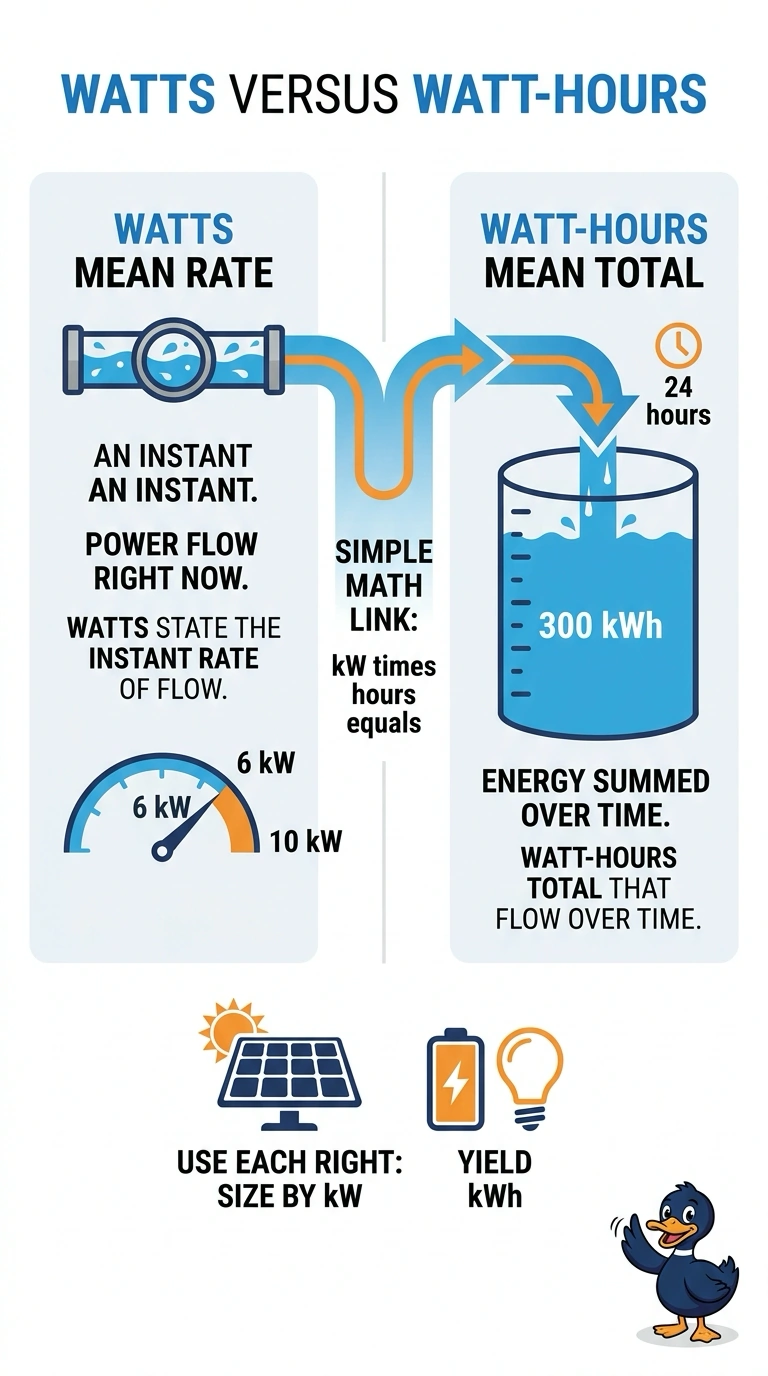
You are untangling speed versus distance here, and that clicks fast for owners. Remember rate versus total: watts are how fast power flows right now, watt-hours add it up over hours.
Full Explanation
Power in watts is an instantaneous rate of energy transfer while energy in watt-hours integrates that rate over time, so a 6-kW array operating at full rate for four hours yields about 24 kWh. The correct statement preserves that rate-versus-accumulation relationship and explains both the panel rating and daily production and storage capacity in consistent terms. Reversing the definitions fails by concept because it swaps rate and accumulation and would misread inverter size as daily yield. Treating the units as interchangeable fails by concept because it ignores time and leads to undersized storage and misestimated savings. Assigning watt-hours to noon output and watts to overnight storage fails by concept because it ties units to time of day rather than to physical meaning. Exam caveat is to multiply kW by hours to check kWh answers, and practical check is to compare nameplate kW to metered kWh over a known sunny period.