
A crew arrives at a flat commercial roof to set two pallets of modules, a pallet of ballast blocks, and rails for a next-day install. The roof has marked walk paths, drains, and long spans between supports. Which staging plan best protects the roof with load distribution in mind?
Select an answer to reveal the explanation.
Short Explanation
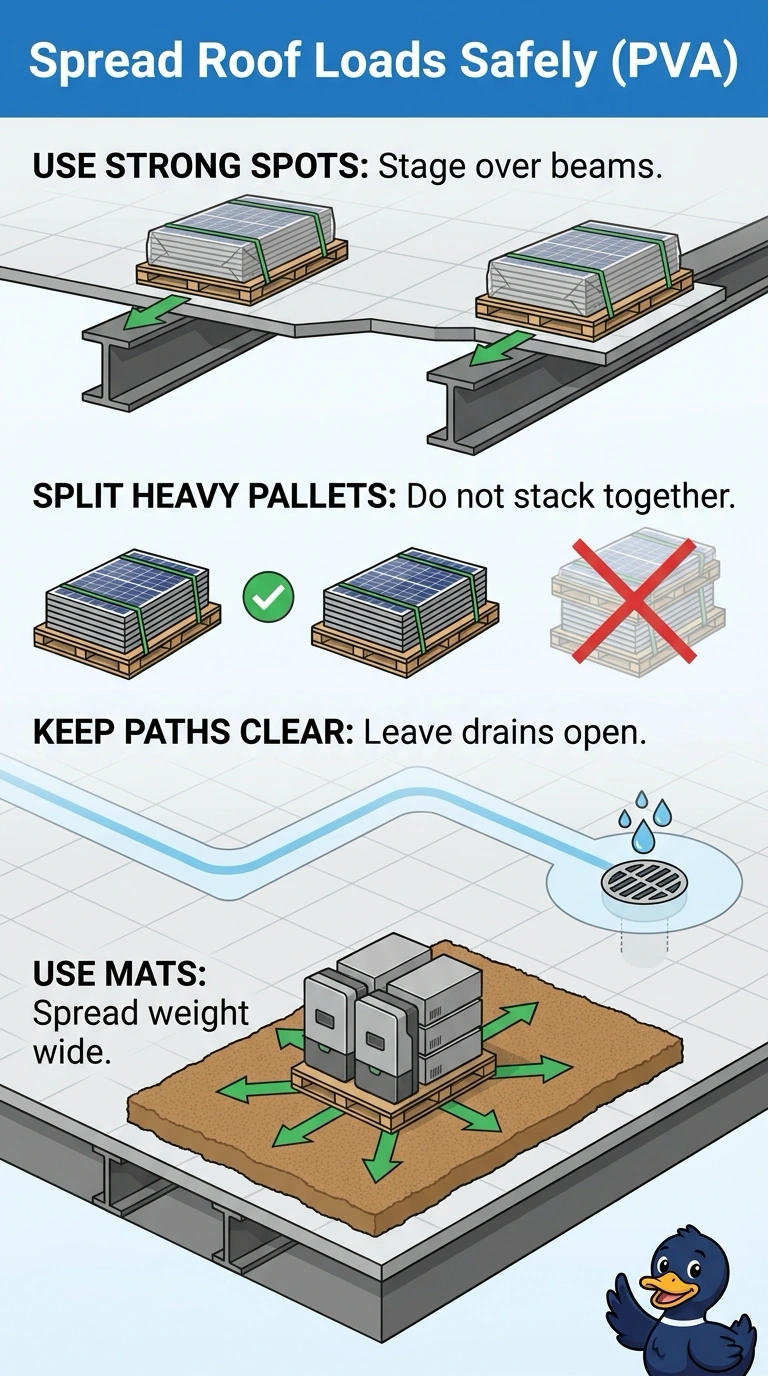
You want to share the weight like books across a strong shelf, not leave one heavy pile on a long span. Keeping stacks near supports, using mats under concentrated loads, and leaving paths and drains clear helps protect the roof and crew.
Full Explanation
Placing pallets near columns over supported framing, keeping drains and marked paths clear, and using mats beneath concentrated stacks is best because the supports can carry the loads more effectively than long unsupported spans, while mats help protect the roof surface and spread local pressure. Staging separated stacks on mats in open mid-span bays keeps paths and drains clear, but mats do not make long unsupported spans suitable for concentrated loads. Placing stacks on mats over column supports protects the roof and avoids blocking drains, but using a marked walk path as a staging lane obstructs the route intended for crew movement. Placing pallets near columns over supported framing and keeping paths and drains clear is sensible, but relying on pallet skids without roof mats omits the protective, load-spreading layer beneath concentrated stacks. An exam caveat: being near a column does not by itself confirm the actual support layout or allowable roof loading. Before staging materials, verify support locations and roof capacity using site drawings or with the responsible building professional, then confirm that the mats and staging arrangement are approved for the roof system.