
A two-person crew must lift three 45-lb modules and hand tools to a single-story roof edge with a public walkway below and gusts picking up. The lead wants controlled lifts and no dropped objects. Which hoisting, rigging and tool-tethering method best controls the lift?
Select an answer to reveal the explanation.
Short Explanation
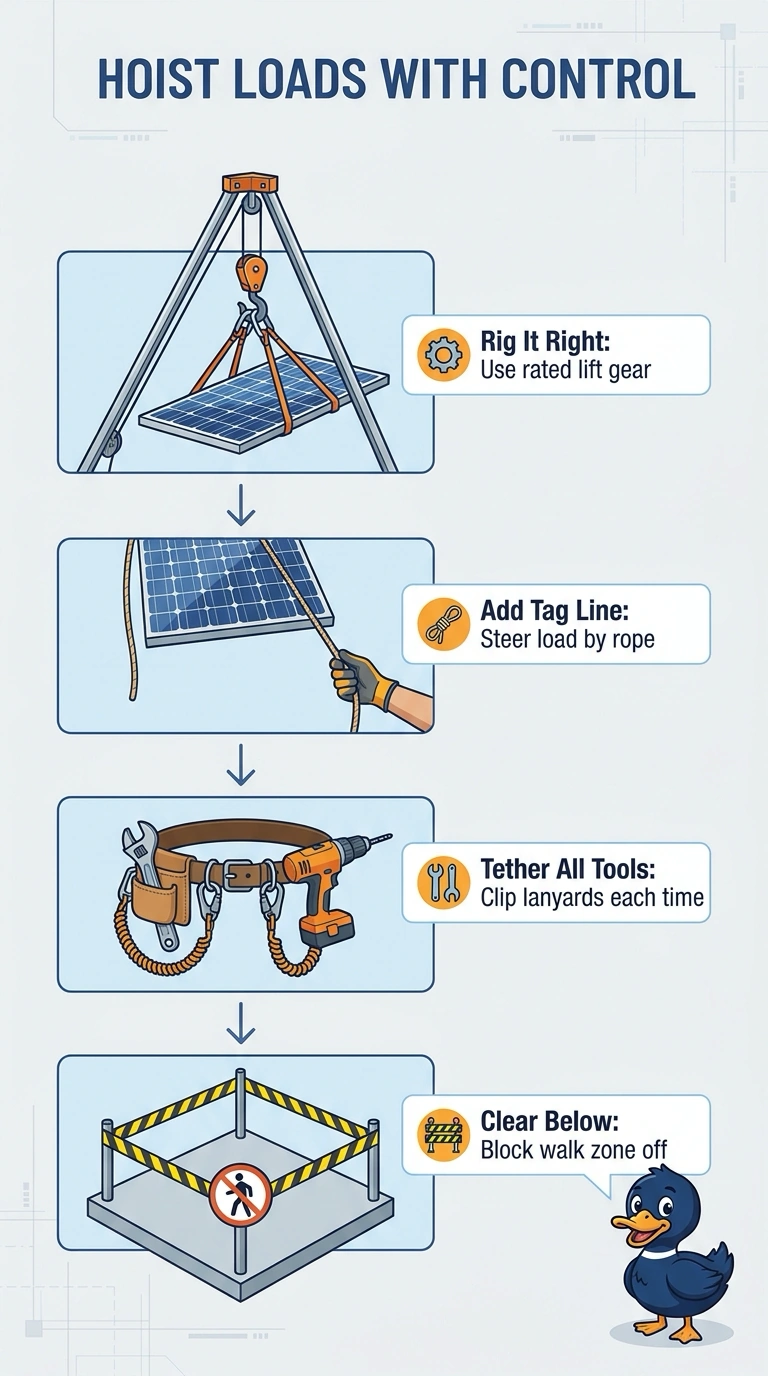
With gusts picking up, loose gear can quickly become a falling hazard. A gin pole, tag line, tool tethers, and a barricade give you load control and help keep people below safe, like a leash keeping a strong pull steady.
Full Explanation
The method using a gin pole with a tag line, tool tethers, and a barricade controls the lift as a whole: the tag line lets the crew guide the modules, tethers keep hand tools from falling, and the barricade keeps the public out of the drop zone. A rated hoist with tethered tools and a barricade addresses tool retention and public access, but lifting without a tag line leaves a suspended module more vulnerable to swinging or rotating in gusts. A gin pole and tag line with tools in a closed bucket and a barricade guides the modules and keeps the walkway clear, but a bucket is not a substitute for individual tool tethers; tools can shift or spill as it moves. A gin pole with a tag line and tool tethers, watched by a spotter while the walkway stays open, provides load guidance and tool retention, but a spotter does not physically prevent pedestrians from entering beneath the load. Exam caveat: a tag line controls load orientation and swing; it does not make overloaded or poorly secured rigging safe. Practical check: before lifting, confirm the gin pole, rigging, attachment points, and tethers suit their loads, the tag line can be handled without entering the drop zone, and the barricades fully close public access below.