
A homeowner with a 5-kW rooftop system says the monitoring app showed 4 kW at noon and 20 kWh for the day, and asks why the two numbers differ when both describe system output on a clear day with no outage. Which explanation correctly distinguishes power (W) from energy (Wh) for this PV system?
Select an answer to reveal the explanation.
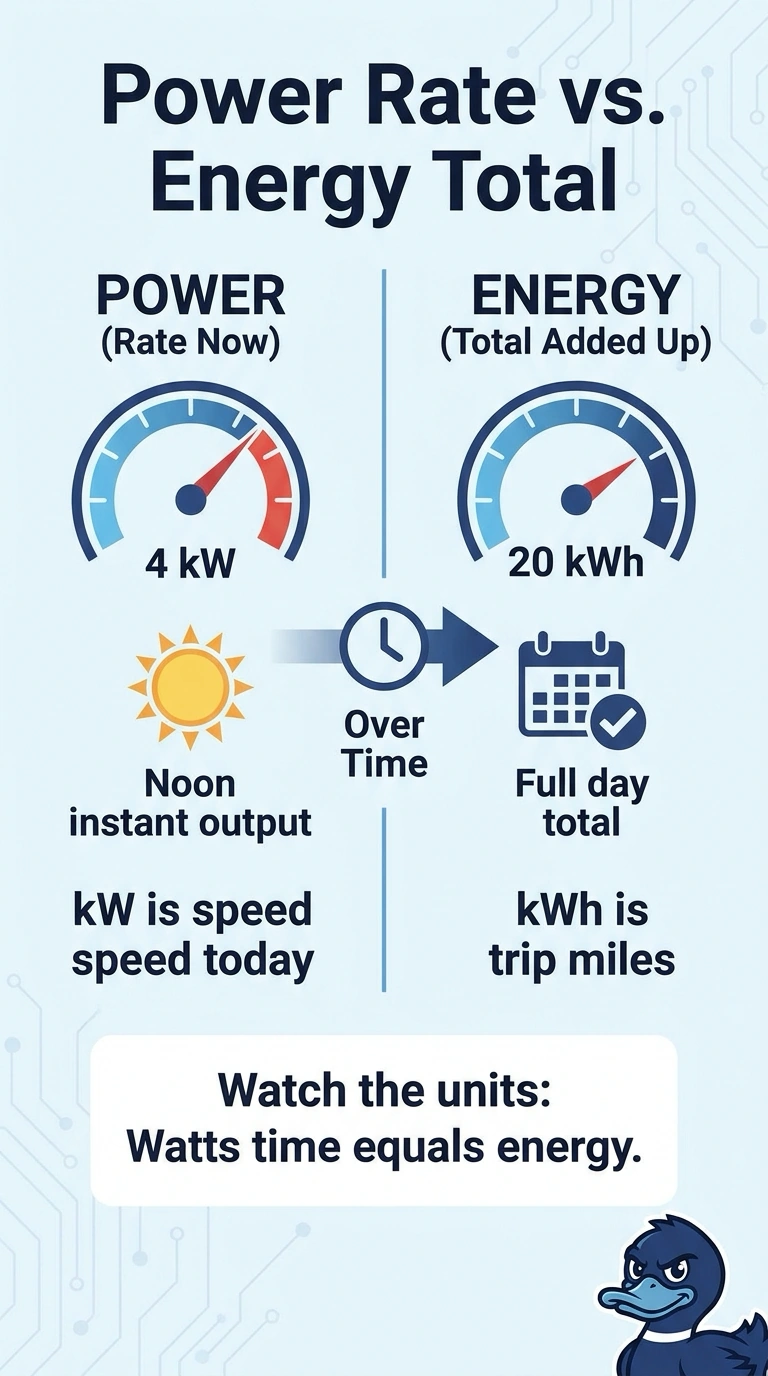
Short Explanation
You’re untangling a classic mix-up that trips up new sellers and owners alike. Instant rate versus total over time is the split that makes noon power and daily energy click.
Full Explanation
The correct explanation distinguishes power from energy by what each quantity measures: kilowatts describe a rate of energy production at a particular moment, whereas kilowatt-hours measure energy accumulated over an interval. Thus, 4 kW is the reported output at noon, and 20 kWh is the energy generated across the day; the figures differ because the system’s output changes over time. Calling 20 kWh a fixed clear-sky daily rating confuses measured generation for that day with a rating or estimate. Identifying 20 kWh as accumulated energy is correct, but calling 4 kW the average daytime output mislabels a single noon reading; that reading cannot establish the average over daylight hours. Multiplying 4 kW by five hours is a valid power-times-time calculation, but it assumes the system maintained 4 kW for exactly five hours and that this interval accounts for the entire day’s generation. A clear day does not imply constant output, and the daily total reflects output over all relevant intervals. Exam caveat: a kilowatt-hour is a unit of energy, not power, even when an app displays both figures side by side. Practical check: inspect the app’s time-series power graph and compare its area over the day with the reported energy total.