
You are laying out flush-mount rails on a comp-shingle home with 24-in. on-center trusses, per the rail maker table that limits support spacing and rail overhang past the last mount. You find truss lines with a stud finder and attic check, then mark two rail lines. Which layout check should you verify to confirm span and cantilever compliance?
Select an answer to reveal the explanation.
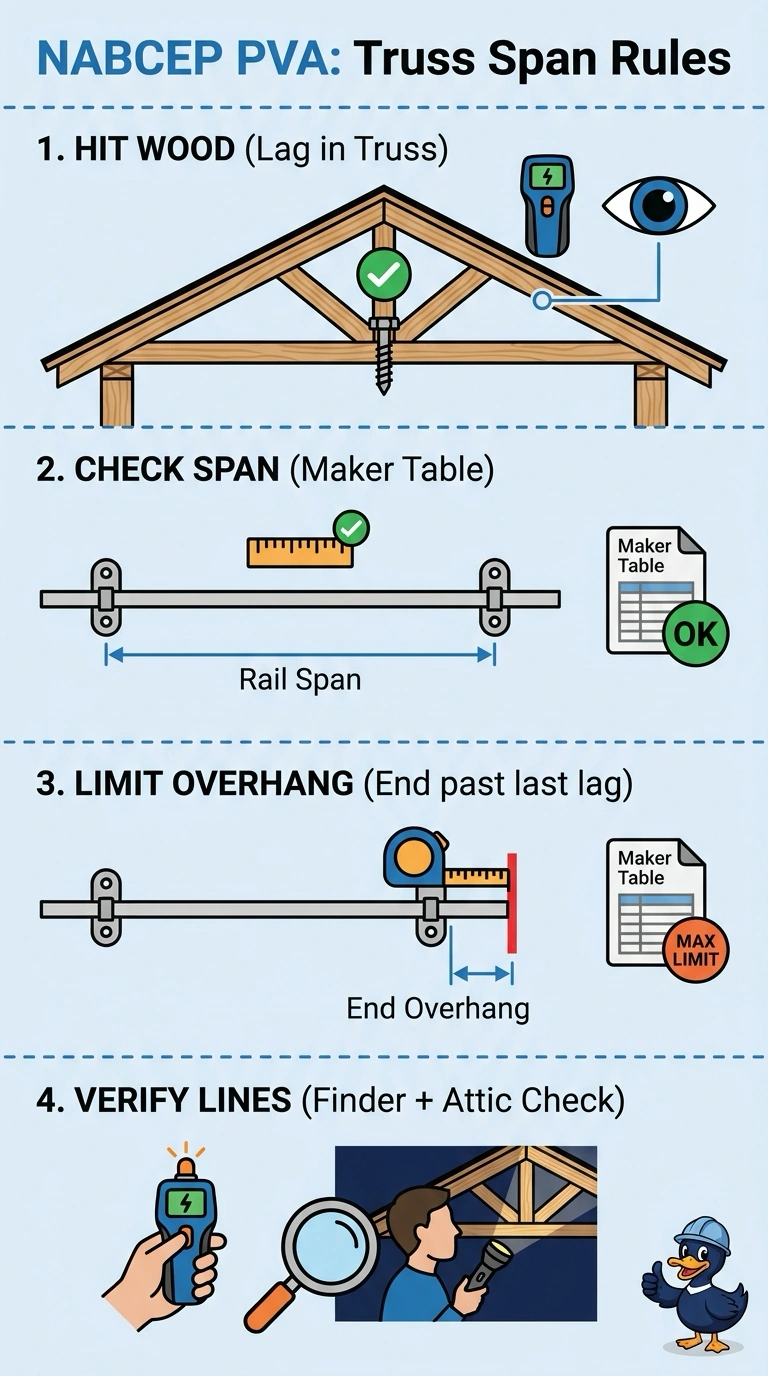
Short Explanation
You’ve found the trusses, and now you can check both the support spacing and the rail overhang against the maker’s limits. Keep each lag in a truss, and measure from support to support and beyond the last mount.
Full Explanation
The required check confirms both limits in the rail maker’s table: the distance between supports and the rail’s overhang beyond the last mount. Confirming that each lag lands in a truss establishes sound attachment, but does not establish that either rail dimension complies. Checking truss attachment and rail span alone leaves the end overhang unverified; a rail can meet its allowable span and still extend too far beyond its last support. Checking truss attachment and end overhang alone omits the distance between supports, so compliant ends do not ensure the rail span is permitted. Checking truss attachment and support spacing, then aligning rails to the module layout, also leaves the allowable end overhang unchecked; module alignment is not a substitute for measuring cantilever. Exam caveat: use the specific rail manufacturer’s table and definitions, since allowable distances can vary by rail, configuration, and loading conditions. Practical check: mark every mount and rail end, measure each support-to-support span and each overhang in the field, and compare both measurements with the applicable table before installation.