
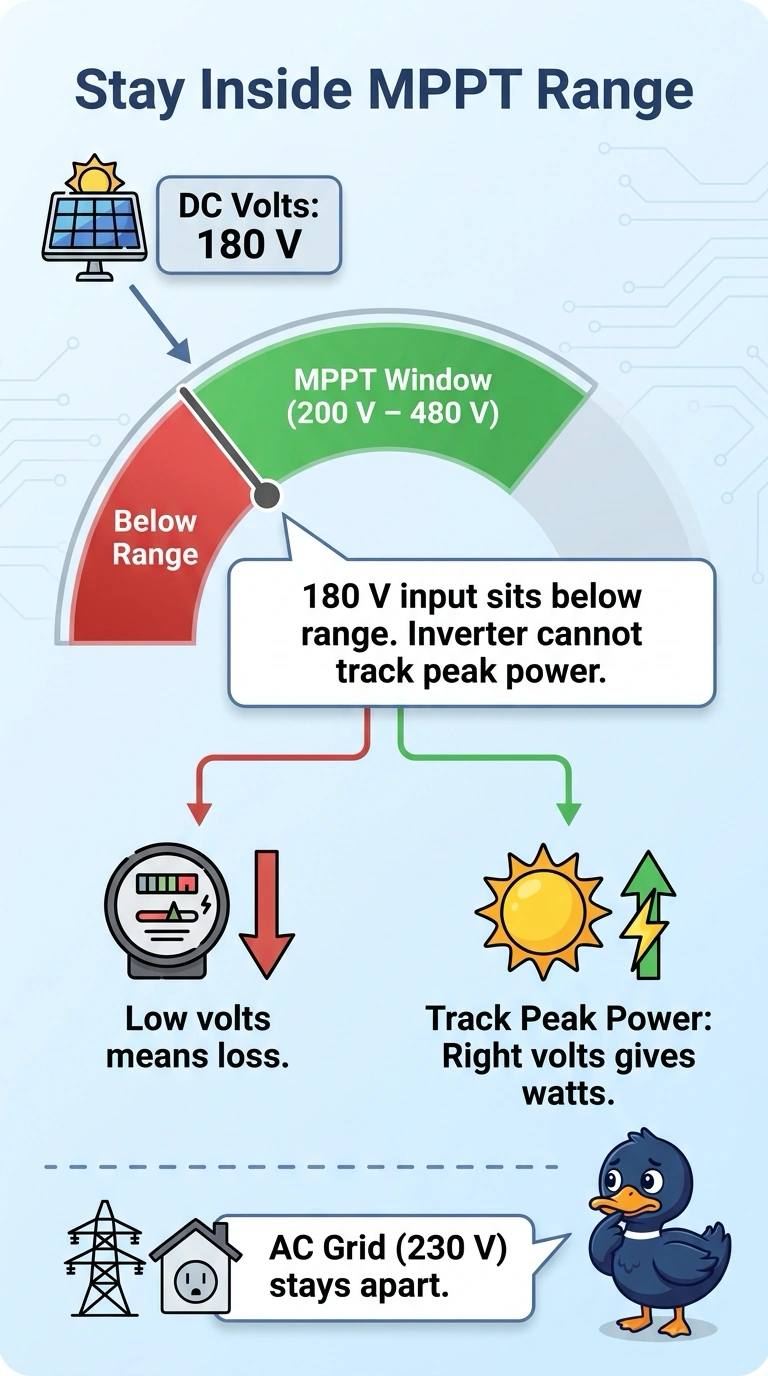
You are checking a 6-kW residential string inverter at midday that lists 230-V AC output and a 200-480-V MPPT range, and the monitoring portal shows 180-V DC input with low power during full sun and no shade or faults logged. Which interpretation of inverter AC/DC voltage and MPPT range best explains the reduced performance?
Select an answer to reveal the explanation.
Short Explanation
You've spotted the mismatch already — voltage is present but too low to use well. Your MPPT window is where the inverter can actually harvest full power, not just stay on.
Full Explanation
The correct interpretation is that 180 V DC is below the stated 200–480 V MPPT range. The inverter’s 230-V AC rating describes its output voltage; it does not change the DC tracking limits. Below the MPPT window, the inverter cannot operate at the specified tracking conditions, so it may not find and maintain the array’s peak-power point, consistent with low output in full sun. The startup-threshold explanation confuses the voltage needed to wake an inverter with the range in which it can track maximum power: clearing startup voltage alone does not establish normal MPPT operation. The grid-curtailment explanation invokes a real field condition, but a 230-V AC rating is not a grid acceptance threshold or a measurement of actual grid voltage; it cannot establish grid-related derating here. The nominal-target explanation misreads the stated range: 200 V is explicitly its lower MPPT limit, not a preferred target that can be disregarded. Exam caveat: startup voltage, absolute maximum DC voltage, and MPPT operating limits are separate specifications, and a value outside the MPPT range does not by itself identify the underlying fault. Practical check: verify the portal reading against a meter at the inverter under load, then compare the measured string voltage with the inverter manual’s startup and MPPT specifications and the array’s expected operating voltage.