
A site survey of a 1990s house shows a 200 A service panel with a 225 A bus rating, ten free breaker spaces, and a rust-free enclosure. The homeowner wants a 9.6 kW array whose inverter output breaker is 40 A. Which evaluation determines whether this load-side connection fits the panel's busbar capacity?
Select an answer to reveal the explanation.
Short Explanation
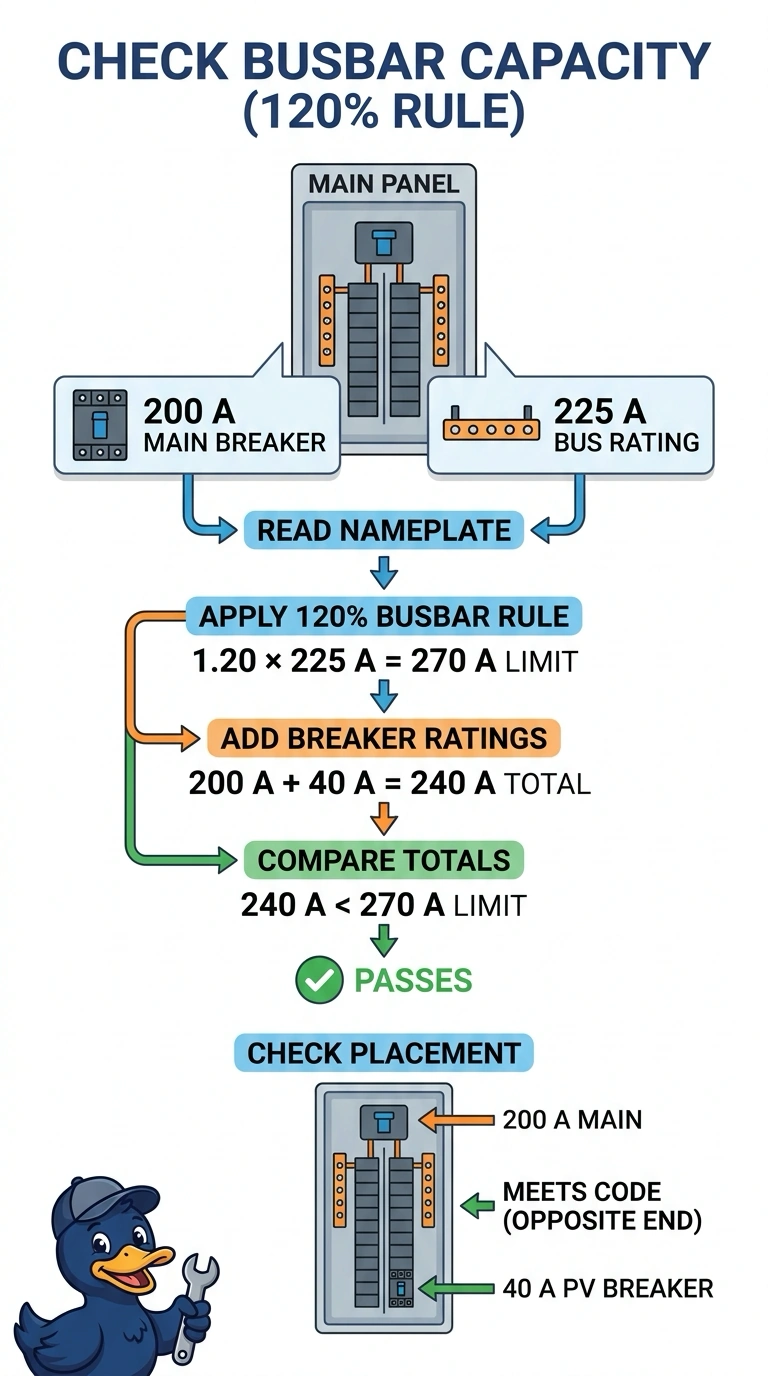
Free spaces tell you where a breaker may fit, not whether the busbar can accommodate the connection. For this load-side connection, check the applicable busbar rule: 200 A + 40 A is less than 120% of 225 A (270 A), subject to the required breaker placement and applicable code edition.
Full Explanation
For a typical load-side PV connection evaluated under the 120% busbar rule, add the main-breaker rating to the PV inverter output breaker rating and compare the sum with 120% of the panel busbar rating. Here, 200 A + 40 A = 240 A, while 120% of 225 A is 270 A; because 240 A is below 270 A, the connection meets this busbar-capacity test. Counting unused breaker spaces is a physical-fit check: ten spaces may accommodate a two-pole 40 A breaker, but space alone says nothing about the busbar’s permitted current. A service-load calculation compares demand with the 200 A service rating and can assess service capacity, but it does not replace the busbar interconnection calculation. An available-fault-current/SCCR evaluation checks whether equipment can safely withstand fault current; it is not a test of whether the main-plus-PV breaker ratings satisfy the busbar rule. Exam caveat: passing the 120% calculation does not by itself approve the connection; required breaker placement and the applicable code edition also matter. Practical check: verify the panel label or listing for the 225 A bus rating, confirm the 200 A main and 40 A PV breaker ratings, and check the permitted breaker position and code requirements.