
On a 12-kW rooftop retrofit the crew must land stranded aluminum feeder conductors in a combiner with lugs marked CU-ONLY, the site is coastal and damp, and the foreman wants a durable low-resistance joint. Which conductor and termination compatibility rule should the installer apply to make this connection safe?
Select an answer to reveal the explanation.
Short Explanation
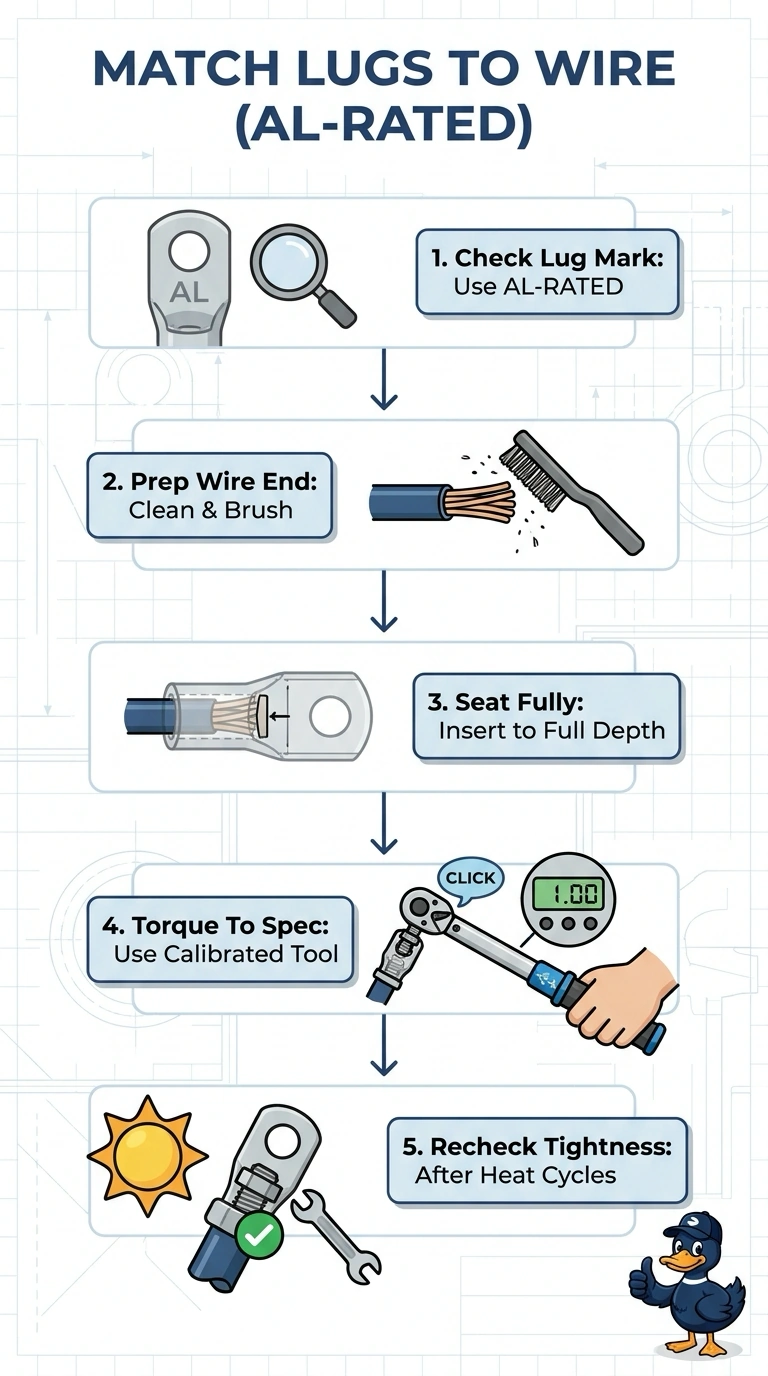
You have got to match metals that are made to live together, like pairing the right shoes for a hike. Swapping to listed AL-rated lugs and torquing them gives you a joint that stays tight in damp air.
Full Explanation
Replacing the CU-ONLY lugs with listed lugs rated for aluminum addresses the basic conductor-to-terminal compatibility issue. Preparing the stranded aluminum as directed and applying the lug’s specified torque help limit oxide-related resistance and maintain the intended clamping force, both important for a durable connection in a damp coastal setting. The dry-location-only AL-rated lugs fail because the installation environment is damp; a lug’s conductor-metal rating does not establish suitability for that location. A listed AL/CU splice can make a sound aluminum-to-copper transition, and the copper pigtails can land in CU-ONLY lugs, but a splice rated only for dry locations is not suitable for this site. The “usual” torque for a lug size is not a substitute for the torque value specified for the particular listed lug; using a generic value can leave the connection under- or over-tightened. Exam caveat: antioxidant compound is not a substitute for an aluminum-rated termination, and it should be used only as directed by the connector manufacturer. Practical check: verify the lug and any splice markings and instructions for conductor material, strand class and size, wet-location suitability, preparation, and required torque before installation.