
You are checking a residential plan set for exposed rooftop source circuits in conduit on a hot dark roof that stays wet and sunlit. Notes call for continuous current, high ambient derate, and wet location use. Which conductor selection meets temperature rating, ampacity, UV and moisture requirements?
Select an answer to reveal the explanation.
Short Explanation
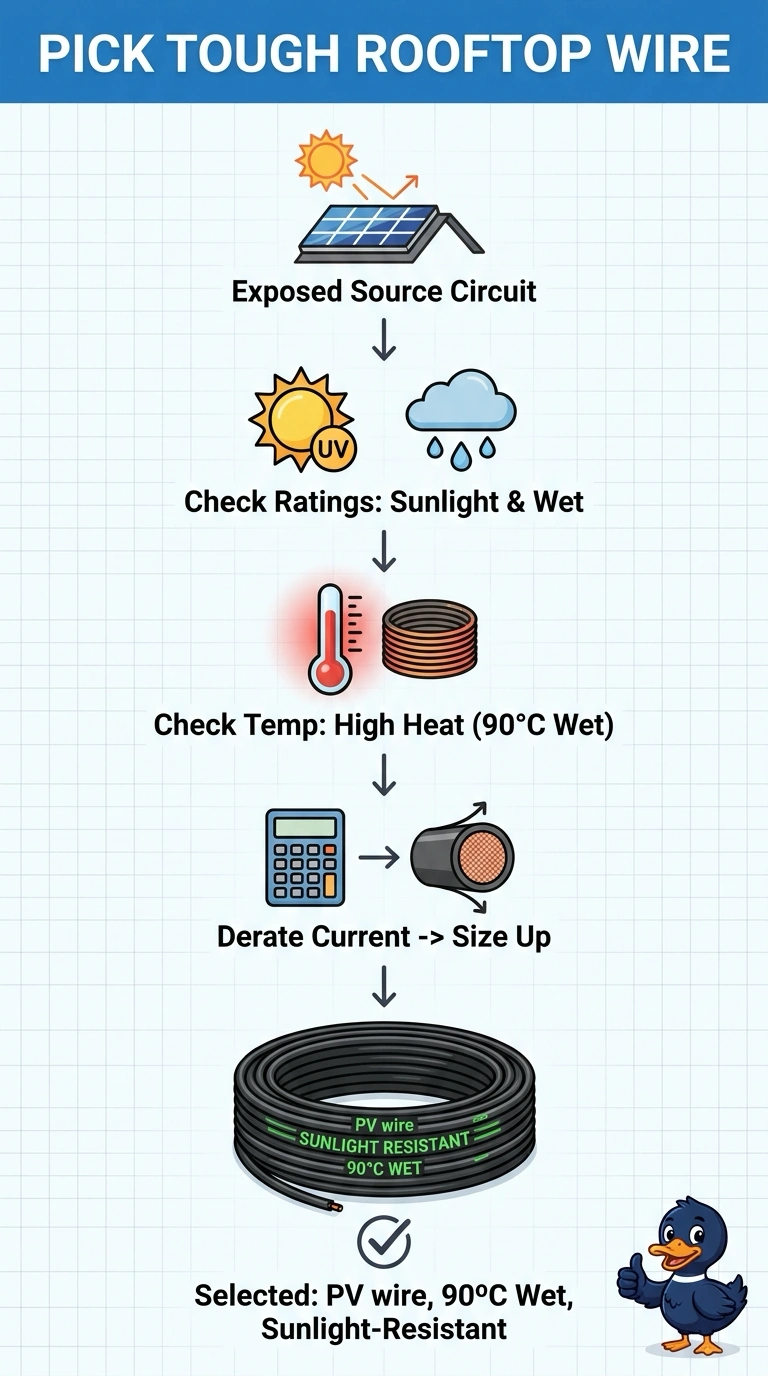
You nailed the tough part where heat, sun, and water meet. Rooftop wire is like sunscreen plus raincoat in one, and sunlight-resistant 90C wet rating covers all three.
Full Explanation
Sunlight-resistant PV wire rated 90°C wet is the best match for exposed rooftop source circuits: its wet-location and sunlight markings address persistent moisture and UV exposure, while its 90°C rating provides the temperature basis needed for high-ambient correction. The conductor still must be sized for the continuous load and all applicable correction and adjustment factors; the 90°C rating does not by itself establish adequate ampacity. THWN-2 is a common 90°C-wet choice and can be suitable in an appropriate raceway, but unmarked PVC raceway is not established as sunlight resistant, leaving the exposed wiring system short of the stated UV requirement. USE-2 is also commonly used outdoors and is sunlight resistant and rated 90°C wet, but sizing it without the continuous-load adjustment can leave its ampacity inadequate for continuous current. Dual-rated THHN/THWN conductors are common in raceway, but their wet-location rating is 75°C; using that lower rating fails the specified 90°C wet temperature basis for rooftop derating. Exam caveat: a 90°C insulation rating is generally a starting point for correction calculations, not permission to exceed equipment termination temperature limits. Practical check: verify conductor and raceway markings, load duration, ambient temperature, and terminal ratings against the applicable code rules and product instructions.