
A designer in Portland must place 24 modules on a split roof where a chimney shades the lower west section from 2 to 5 p.m. and a maple shades the east edge in the morning. Production modeling is required for the permit. Which shading analysis best informs layout and energy estimates for design and performance?
Select an answer to reveal the explanation.
Short Explanation
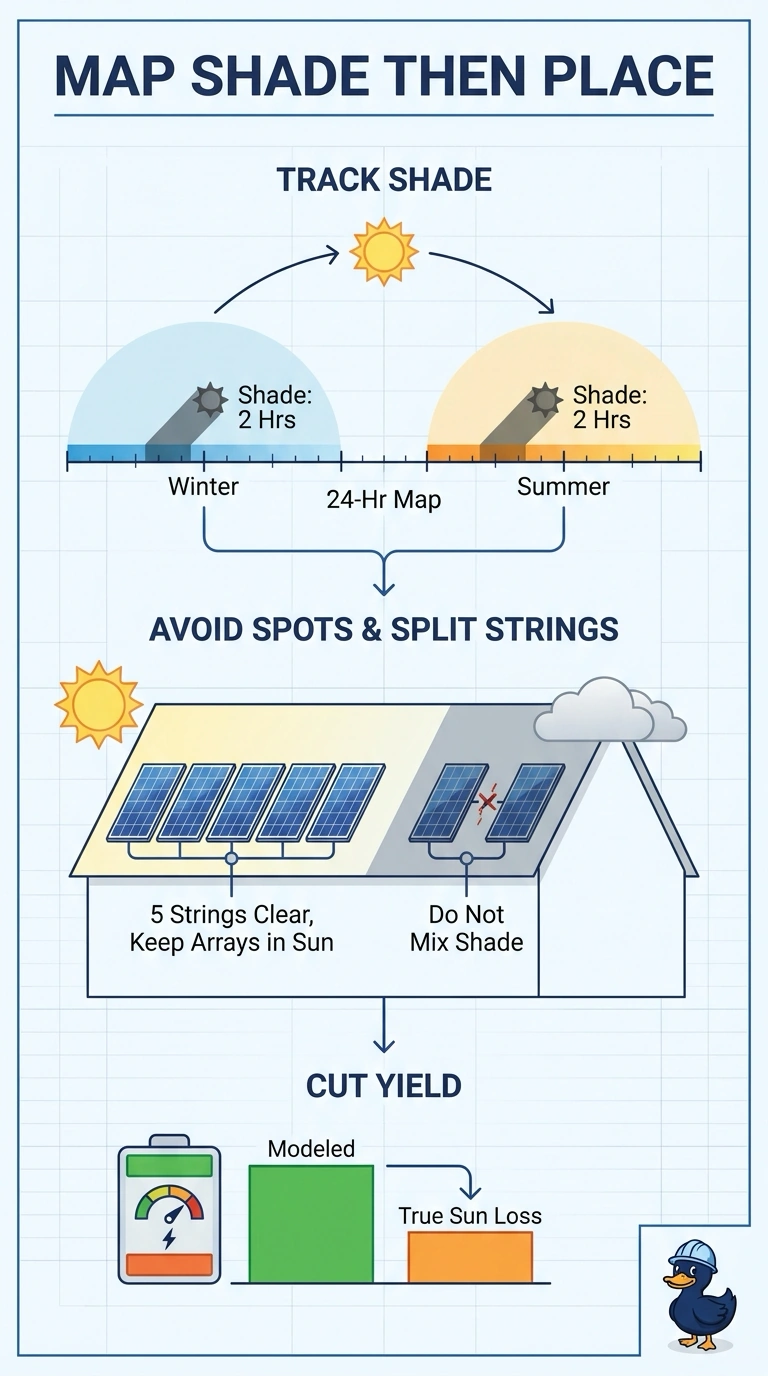
Shade moves like a clock hand across your roof through the day and year. Mapping those hours helps you plan a smart layout and make honest energy estimates. A noon snapshot simply cannot tell that story.
Full Explanation
Mapping shade hour by hour across seasons captures both the chimney’s afternoon shadow on the lower west roof and the maple’s morning shade along the east edge. That timing matters because shade changes the sunlight reaching modules and therefore the energy estimate; identifying affected areas also helps you keep shade out of module strings. Applying appropriate loss derates makes the production model more realistic for permitting and performance expectations. Mapping seasonal hourly shade and isolating shaded modules electrically addresses layout, but omitting shade-loss derates leaves modeled production too high. Checking seasonal sun paths, keeping strings clear of shade, and using standard annual loss derates can support a sound layout, but does not resolve shade by hour; broad seasonal checks can miss when and how long each roof area is shaded, weakening layout decisions and the production estimate. Mapping seasonal hourly shade and derating energy is useful, but adding optimizers to mixed-shade strings does not follow the specified strategy of keeping strings clear of shade. Optimizers can reduce mismatch losses, but they do not make shaded modules unshaded or replace that string-layout strategy. Exam caveat: shade-management electronics may be appropriate where roof geometry prevents clean string separation, but they do not remove the need for accurate shade modeling. In practice, verify the model against a site survey or shade study that records the chimney’s and tree’s seasonal obstruction windows, and confirm the final string map against those affected roof areas.