
You plan three small builds: a sealed membrane flat roof that cannot be pierced, a shingle pitched roof with attic rafters, and an open field with expansive clay. Which mounting type match best fits flat roof, pitched roof, and ground mount needs?
Select an answer to reveal the explanation.
Short Explanation
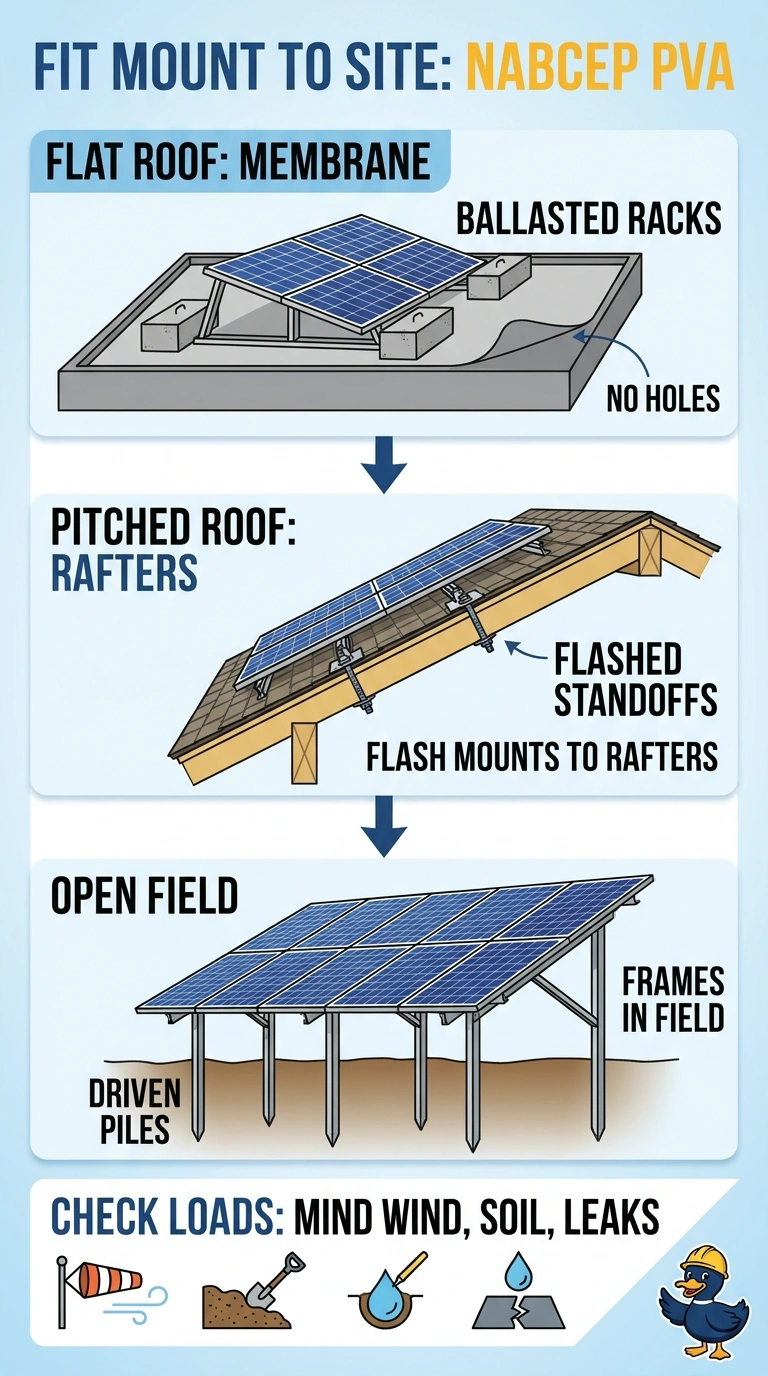
You’re matching mounts to each surface so your roofs stay dry and your array stays secure. Ballasted racks avoid piercing the sealed membrane, flashed standoffs tie into the rafters, and driven piles support the field frame—smart anchoring fits each site.
Full Explanation
Ballasted racks suit the sealed flat roof because their weight resists uplift without piercing the membrane. On the shingle roof, flashed standoffs anchored to the attic rafters provide a structural load path, while the flashings manage water around the penetrations. Driven piles with frames provide a direct ground-mount foundation for the field; their suitability for expansive clay should be confirmed through site-specific engineering. Mechanically anchored, flashed racks on the membrane can be a valid approach when penetrations are allowed and correctly flashed, but they violate the explicit no-piercing requirement here. Engineered deck-rated flashed mounts on the shingle roof can suit some roof assemblies, but they do not make use of the available attic rafters as the specified attachment. Shallow concrete piers with frames are a familiar ground-mount approach, but expansive clay can swell and shrink, shifting or heaving shallow supports unless they are specifically designed for those soil conditions. Exam caveat: a mounting method is not suitable simply because it is commonly used; roof warranties, structural capacity, wind and snow loads, and local code approvals all matter. Practical check: confirm the roof attachment details and membrane requirements, then obtain geotechnical or structural guidance for foundation design at the clay site.