
A maintenance lead suspects soiling plus one weak bypass diode in a 12-module string after a hot dusty month. Open-circuit voltage looks near normal, but midday power sags and infrared shows one hot module. Which IV curve tracer use best isolates the fault?
Select an answer to reveal the explanation.
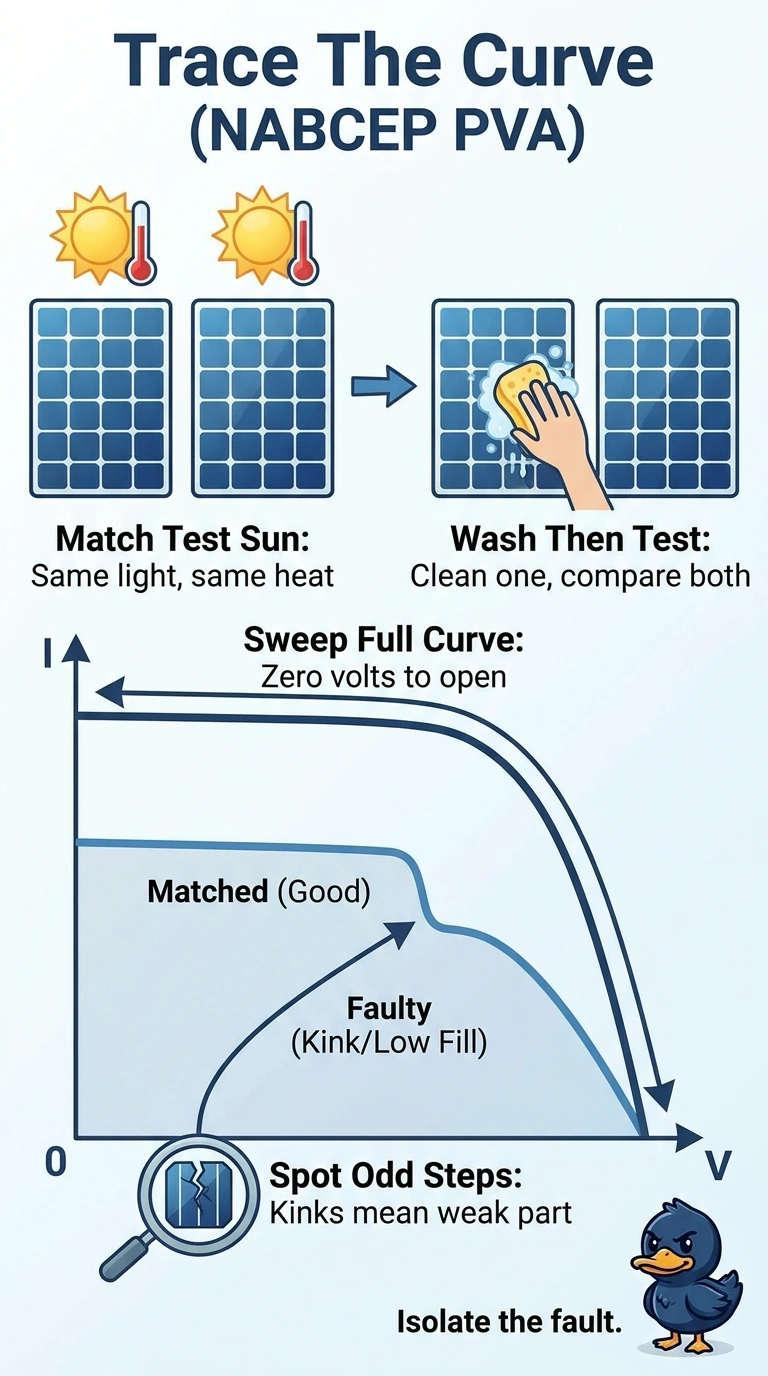
Short Explanation
You're reading the string's heartbeat under matching sun. A clean curve comparison spots dips and flat steps like footprints in fresh snow. Same light makes the clue fair.
Full Explanation
The correct approach sweeps the suspect 12-module string after it has been cleaned and compares the trace with a matched reference string measured within minutes under stable midday sun, with plane-of-array irradiance and cell temperature logged. Cleaning first removes uniform dust, which mainly lowers short-circuit current and maximum power while leaving open-circuit voltage near normal, so any step, notch, or low fill factor that remains points to a weak bypass diode or mismatch and matches the infrared hot module. Judging the string by peak wattage alone fails because it quantifies underperformance without reading curve shape, so it cannot separate a diode step from a uniform loss. Sweeping only to confirm a finished repair fails on sequencing: the trace is needed beforehand to find the fault, not afterward to prove it was fixed. Sweeping dusty strings without cleaning first fails because soiling depresses current and distorts the curve, so the diode signature cannot be separated from the soiling loss. Exam caveat: when voltage is described as near normal, prioritize fill factor and steps over Voc and Isc alone. Practical check: log irradiance, temperature, timestamp and soiling state, and if the soiling loss itself must be quantified, take one as-found trace before cleaning and a second after.