
A trainee measures a residential string at 380 V and 9 A at midday and must verify expected power and check whether a 10-A series fuse rating leaves safe margin before calling the lead. Which application of Ohm's law and power relationships best completes this check?
Select an answer to reveal the explanation.
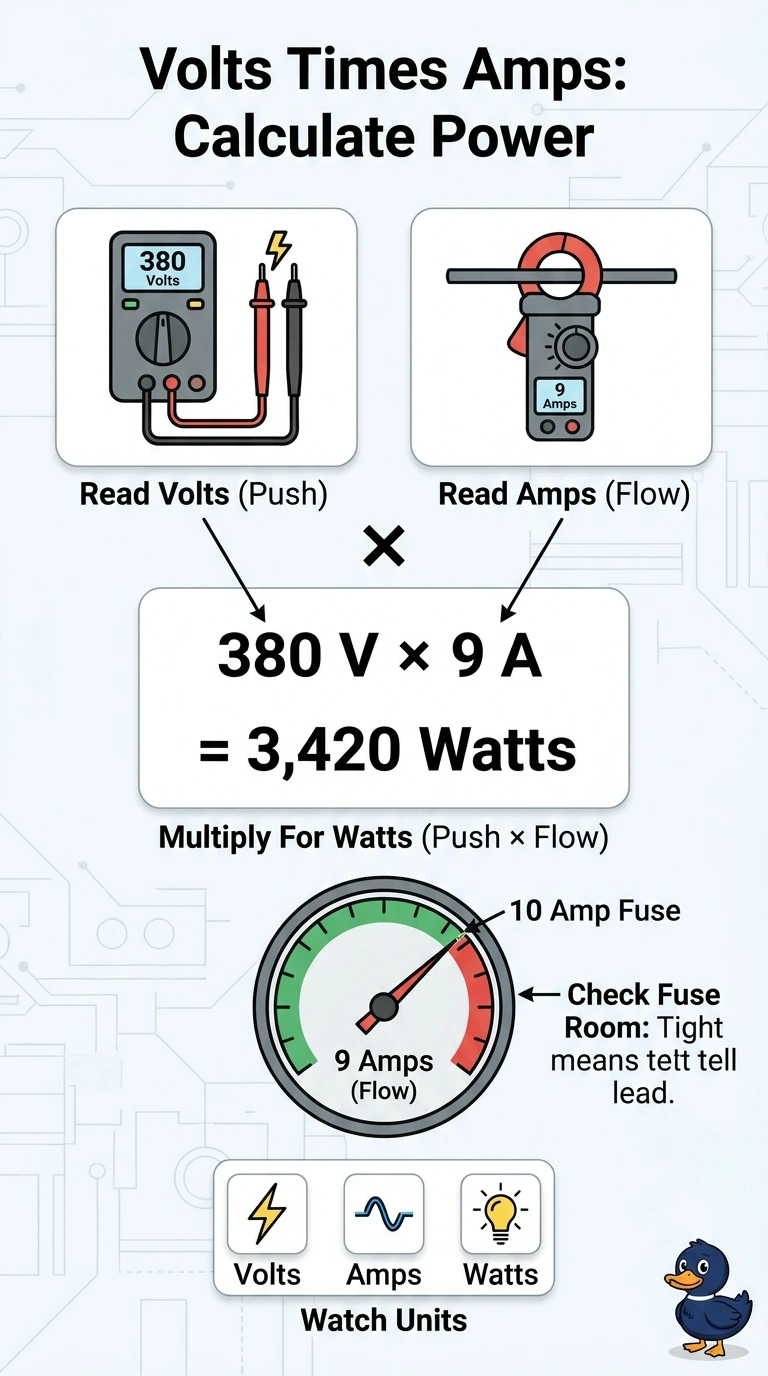
Short Explanation
You’ve got the math muscle: power is push times flow. Volts times amps gives you 3,420 W here, while the 1-A gap below the fuse rating means the margin is tight, not ample.
Full Explanation
The measured voltage and current give electrical power directly: 380 V × 9 A = 3,420 W. The fuse comparison is separate: a 9-A operating current is only 1 A, or 10% of the 10-A fuse rating, so the margin is tight rather than ample. Reporting 3,420 W but treating that 1-A gap as generous headroom gets the power right but misjudges the safety margin. Applying a 125% continuous-current sizing factor to get an 11.25-A fuse need and call the 10-A fuse undersized borrows a familiar sizing factor; it can matter when selecting protection under applicable rules, but does not by itself establish that this measured operating condition requires replacing the stated fuse. Applying a 95% inverter-efficiency factor to report about 3,249 W confuses string power with converted output power: no inverter conversion is requested, and efficiency does not change the string’s measured electrical power or fuse current. Exam caveat: actual fuse suitability depends on applicable code, fuse type, temperature, conductor ampacity, and equipment limits, not just one midday reading. Practical check: confirm the fuse’s exact rating and time-current characteristics, then compare operating and maximum expected string current with module and conductor specifications.