
A crew is drilling 3/8-inch holes into a concrete foundation wall to hang rail brackets, and the site silica plan requires a vacuum shroud on any concrete drilling while site rules call for eye and hearing protection on rotary hammer work. The drill chart calls for hammer-rotation on concrete and rotation-only on wood and metal. Which drill setup covers every requirement for these foundation holes?
Select an answer to reveal the explanation.
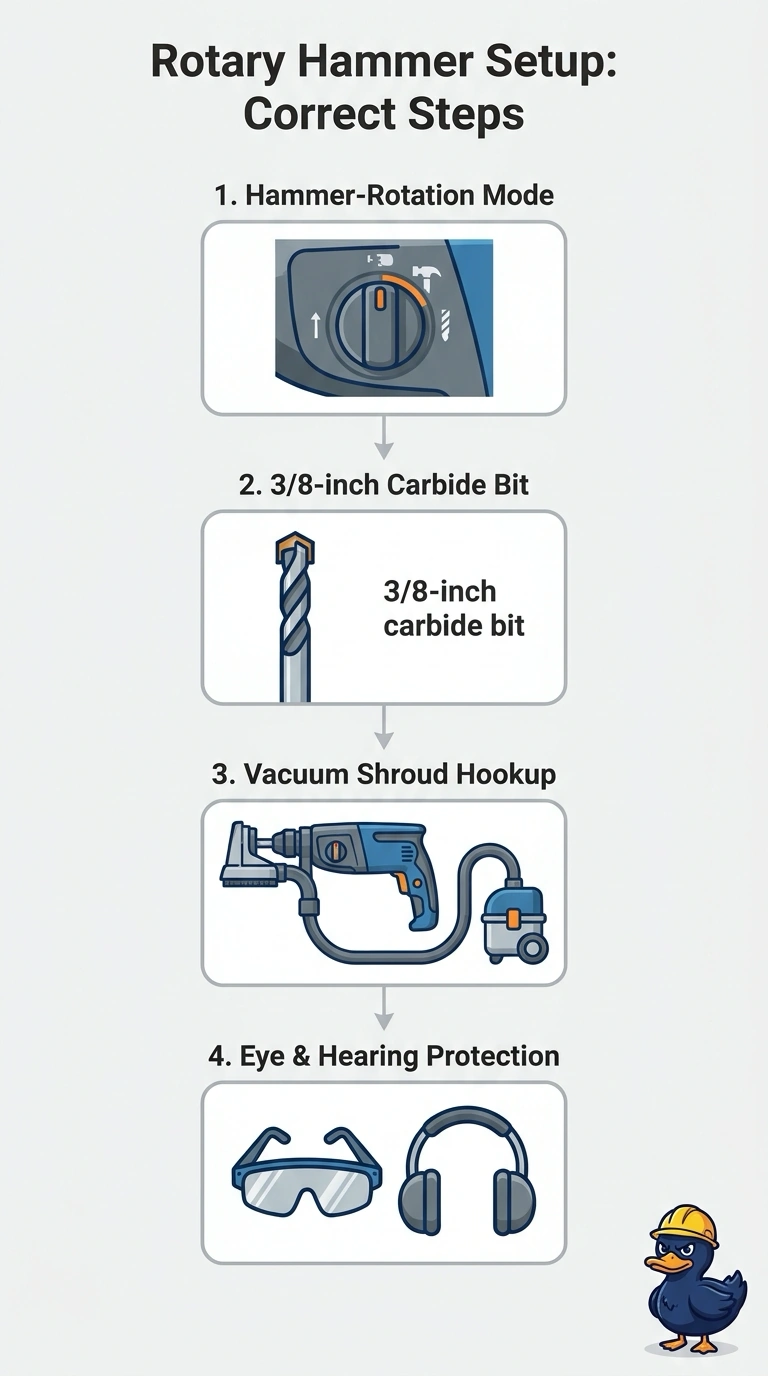
Short Explanation
You've got three site requirements stacked on one hole, and only the full setup covers all of them. In rotation-only mode, the bit spins without hammering, so drilling concrete is generally slower. A mask does not replace the shroud the plan requires.
Full Explanation
Concrete drilling has three requirements working at once: the drill chart assigns hammer-rotation to concrete because a carbide bit cuts by percussion as well as rotation, the vacuum shroud is the engineering control the silica plan calls for because it captures dust at the bit, and eye plus hearing protection covers the chips and noise the hammer action produces. Rotation-only mode is reserved for wood and metal according to the chart, so it is not the specified mode for these holes. Substituting a disposable mask for the shroud misses the control the plan specifies; a mask is not necessarily an appropriate respirator for silica exposure. Safety glasses with a dust mask leave the ears uncovered and do not meet the site’s hearing-protection requirement. Before drilling, confirm the mode, bit, shroud, and required PPE.