
During commissioning of a 6-kW residential string in Boise you read 240 Vdc and 20 Adc at the inverter input on a clear cool morning. The lead asks you to verify expected DC power and check consistency with meter readings. Which application of Ohm's law and power relationships correctly validates the operating point?
Select an answer to reveal the explanation.
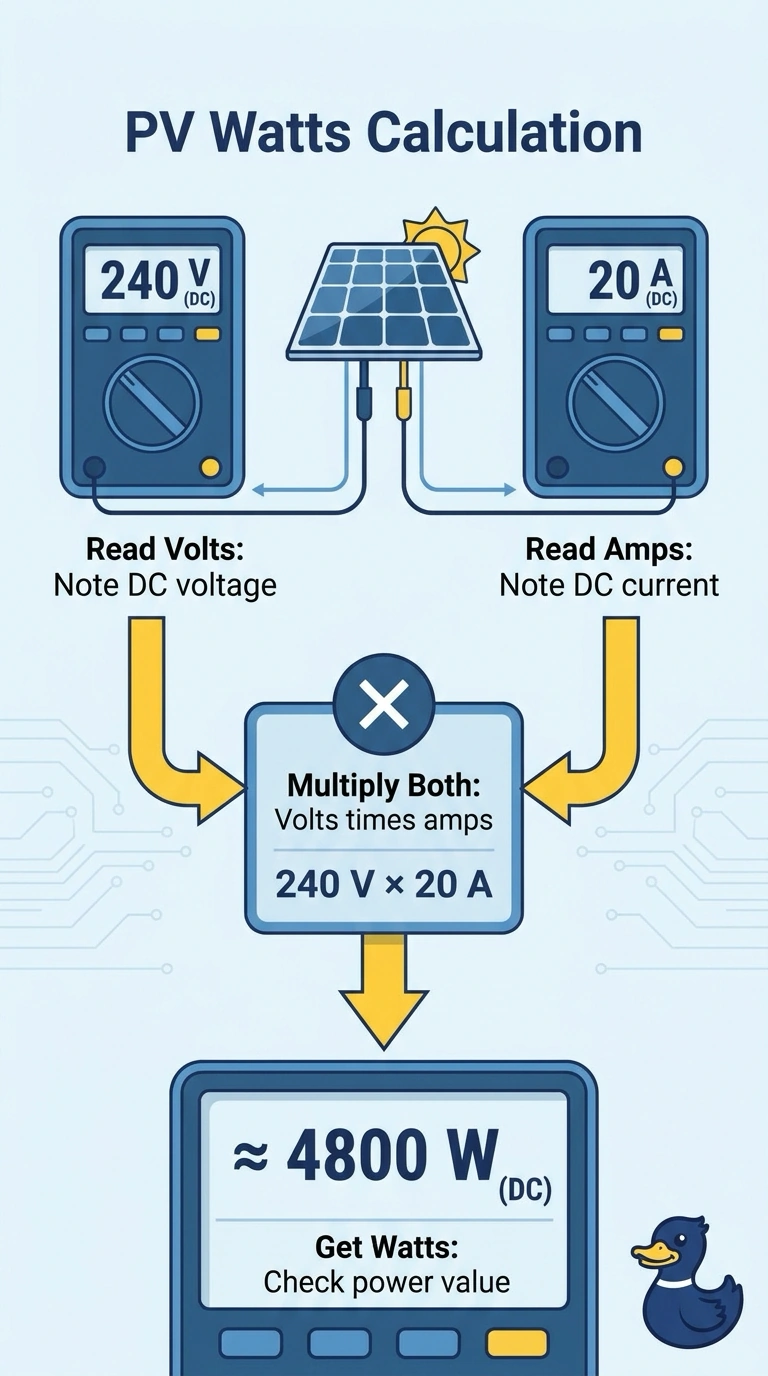
Short Explanation
You already have the two numbers that make power — volts times amps. That simple math gives you watts to cross-check the screen. No adding, no extra dividing, just one clean product.
Full Explanation
The correct validation uses the DC quantities measured at the same operating point: power is voltage multiplied by current, so 240 V × 20 A = 4,800 W, or 4.8 kW. This is the instantaneous DC input power indicated by those readings; it is below the 6-kW array rating, which is plausible because nameplate power is a rating under specified test conditions, not a guarantee of output on a particular cool, clear morning. Treating the 6-kW nameplate as the expected inverter input confuses rated array capacity with actual operating output and therefore cannot verify the meter readings. Converting AC output power back to DC input by dividing by inverter efficiency is a valid method when AC output and an applicable efficiency are known, but neither is supplied here, and it does not directly check the stated DC measurements. Using measured current with nominal string voltage is a reasonable estimate when actual voltage is unavailable, but it substitutes a nominal value for the measured 240 V and may not represent this operating point. Exam caveat: distinguish instantaneous power in watts from energy accumulated over time in watt-hours; do not apply a time factor to a power calculation. Practical check: confirm the meter is set for DC, observe polarity and stable readings, and compare the simultaneous voltage-current product with inverter telemetry while accounting for changing irradiance and temperature.