
A designer in Albuquerque compares two fixed 8-kW proposals for a school: Site A averages 6.2 peak sun hours with light soiling, and Site B averages 4.8 peak sun hours with clear access. Both use the same gear and tilt. Which use of peak sun hours best predicts relative energy for design and performance?
Select an answer to reveal the explanation.
Short Explanation
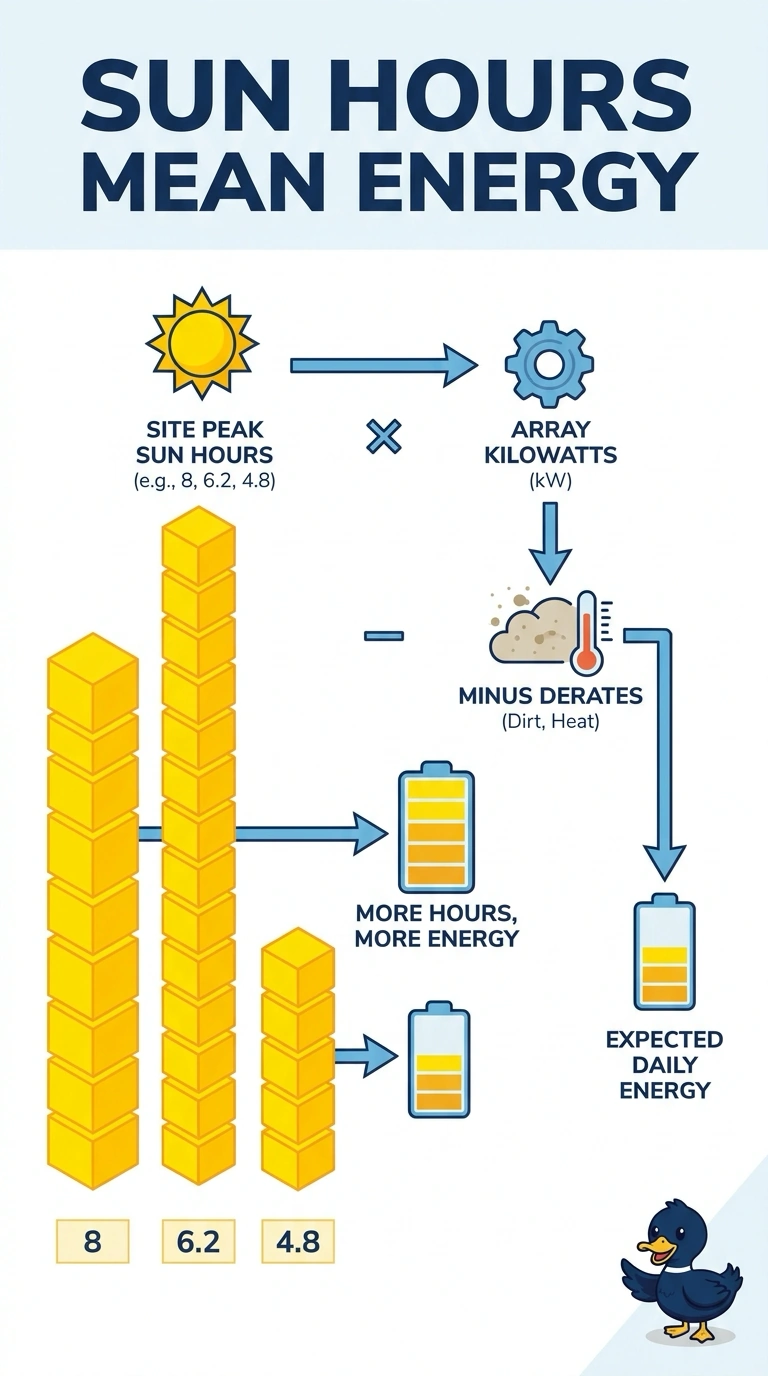
Peak sun hours turn a messy sun day into one clean number you can math with. Kilowatts times sun hours gives daily energy, plain and simple. Site A banks more full-sun blocks, so it should make more kilowatt-hours.
Full Explanation
Peak sun hours represent daily solar energy in equivalent full-sun hours, so multiplying the array’s kilowatt rating by site peak sun hours gives a first-order estimate of daily energy; applying appropriate derates makes the comparison more useful for design and performance. With equal array ratings and otherwise shared equipment and tilt, Site A’s higher average of 6.2 hours suggests greater expected daily production than Site B’s 4.8 hours, subject to site-specific losses. Ranking by peak sun hours alone overlooks the stated difference in soiling and access conditions: even modest differences in soiling or shading can affect delivered energy, so the comparison should account for relevant derates rather than assume they are equivalent. Using inverter kilowatts in place of array kilowatts may be appropriate in an AC-output model, but it does not directly represent the stated array capacity; inverter clipping and the DC-to-AC ratio can change the estimate. Using peak-month rather than average peak sun hours describes a favorable seasonal period, not typical daily energy over the period being compared, and can overstate expected production. Exam caveat: peak sun hours are an energy-equivalent measure, not the number of clock hours of sunshine or the instantaneous noon irradiance. Practical check: confirm whether the 8-kW rating is DC array capacity or AC inverter capacity, then use consistent weather and loss assumptions for both sites.