
A sales associate meets a family with high summer bills, a pool pump, and gas heat. They bring 12 months of electric bills showing kWh use by month, peak demand, rate plan, and net usage notes. Which bill review best qualifies the customer for a PV proposal?
Select an answer to reveal the explanation.
Short Explanation
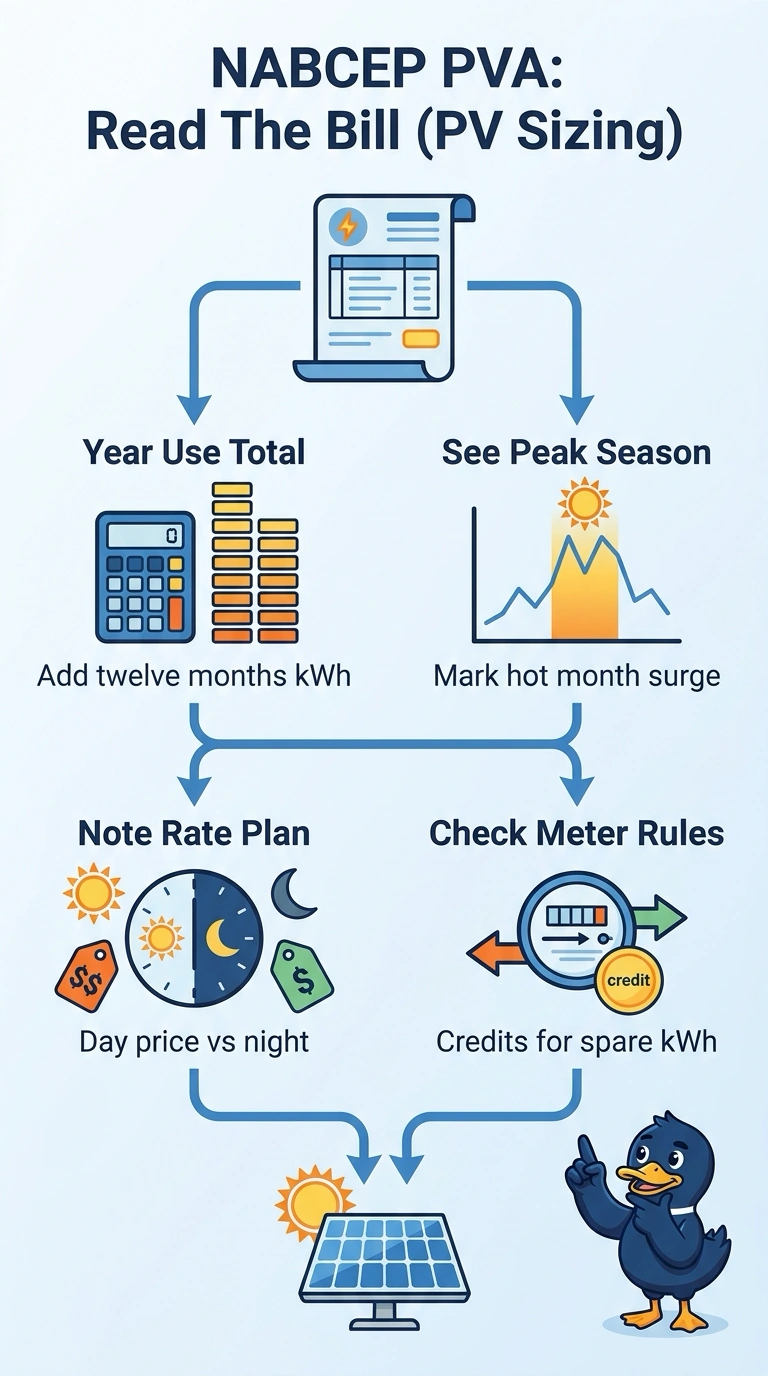
You're reading the home's energy story, not its mailing label. Annual usage with summer spikes and rate rules sizes the array like shoe size fits the foot. Gas and water don't set solar size.
Full Explanation
The correct review succeeds because PV qualification must combine energy quantity, timing, value, and interconnection limits: annual kWh sets system size, 12-month seasonal shape reveals the summer pool-pump peak versus winter gas-heat baseline, rate plan determines time-of-use arbitrage and demand-charge savings, and meter rules govern allowable export, netting interval, and true-up. The full-offset review ignoring meter rules fails by economics and compliance because sizing to 100% kWh without export limits, system-size caps, or net surplus compensation can create non-exportable power with poor payback and utility rejection. The flat-sizing review using yearly average monthly kWh fails by load-shape analysis because averaging smooths away the stated high-summer shape and understates inverter throughput, storage opportunity, and summer bill impact. The combined electric-plus-gas review fails by fuel-scope error because gas heat is not an electric load to offset unless electrification is planned, so adding therms overstates PV kW and misleads production modeling. Exam caveat: do not confuse peak kW demand with energy kWh or assume gas displacement without a heat-pump scope. Practical check: reconcile proposed annual PV kWh to weather-normalized billing kWh, verify summer-month coverage, confirm rate schedule and net-metering tariff with the utility, and document pool schedule before finalizing tilt, azimuth, and size.