
A designer must compare two small commercial sites: a sunny desert roof with 5.8 peak sun hours and a cloudy coastal roof with 3.2 peak sun hours using the same 10-kW array. Which application of peak sun hours should the designer use to predict the difference in daily performance?
Select an answer to reveal the explanation.
Short Explanation
You turned sunshine into math the right way. Multiplying power by sun strength gives yield just like hours worked times pay rate equals wages.
Full Explanation
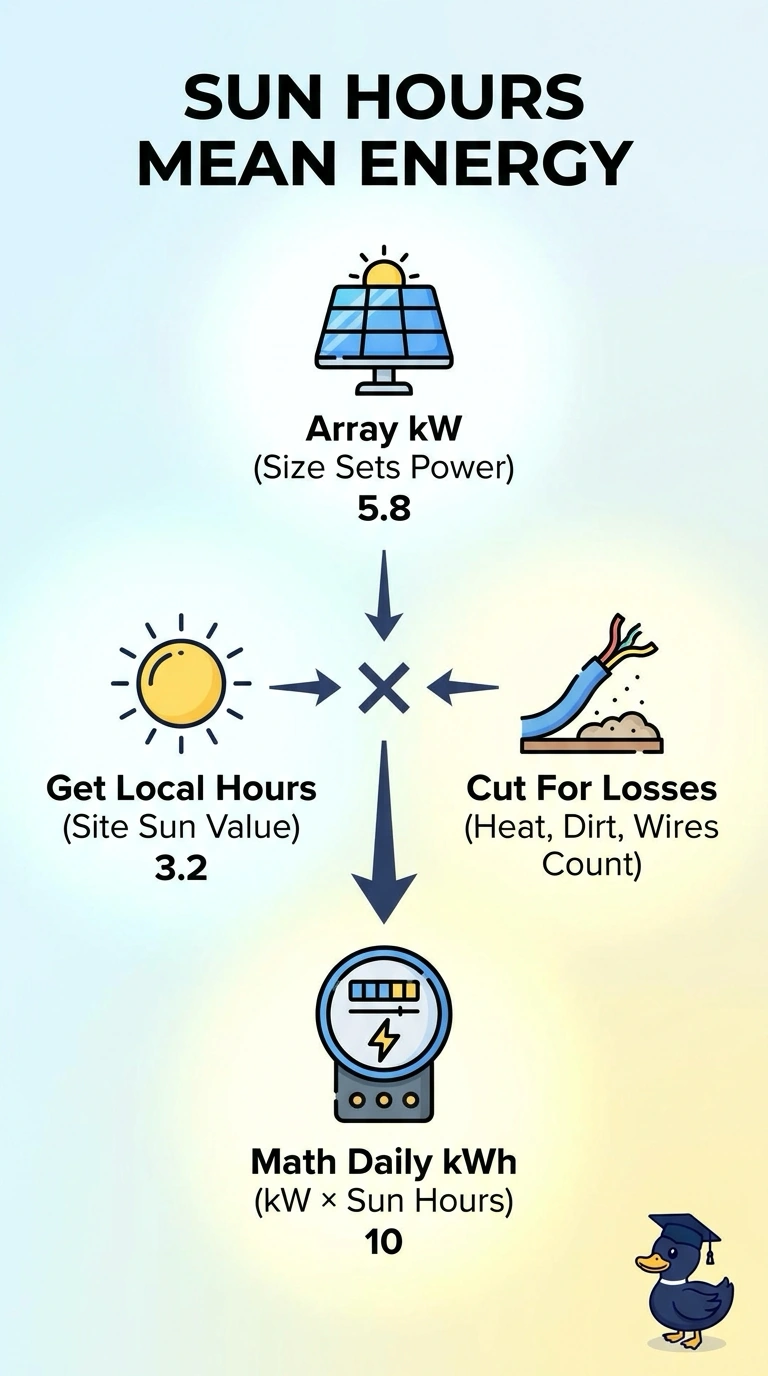
The correct method estimates daily energy by multiplying the array’s 10-kW rating by each site’s peak sun hours, then applying appropriate derates for real-world losses. Before derating, this gives 58 kWh/day for the desert roof and 32 kWh/day for the coastal roof; actual yields will be lower, and the ratio indicates the expected difference under comparable system conditions. Using annual plane-of-array irradiation with a PV model is a sound way to estimate yearly production, but it answers a different time-scale question and can conceal daily variation. Multiplying array capacity by peak sun hours while omitting temperature and balance-of-system losses applies the right basic relationship but overstates delivered energy, so it fails the requirement to account for derates. Converting peak sun hours into equivalent full-sun hours is useful in battery-autonomy planning, but nighttime runtime depends on battery capacity, usable depth of discharge, and load; that calculation does not predict the array’s daily energy yield. Exam caveat: peak sun hours are equivalent full-irradiance hours, not the number of clock hours between sunrise and sunset. In practice, verify that the resource data use a consistent orientation and time period, and use site-specific loss assumptions or a validated PV model for the final estimate.