
You are wiring a 12-kW rooftop string inverter job in Tampa with long conduit runs along a parapet and up to modules. The plan notes wind movement, rain pooling, and sharp enclosure knockouts. Which wiring method best follows best practice for drip loops, bend radius, support, and protection from damage?
Select an answer to reveal the explanation.
Short Explanation
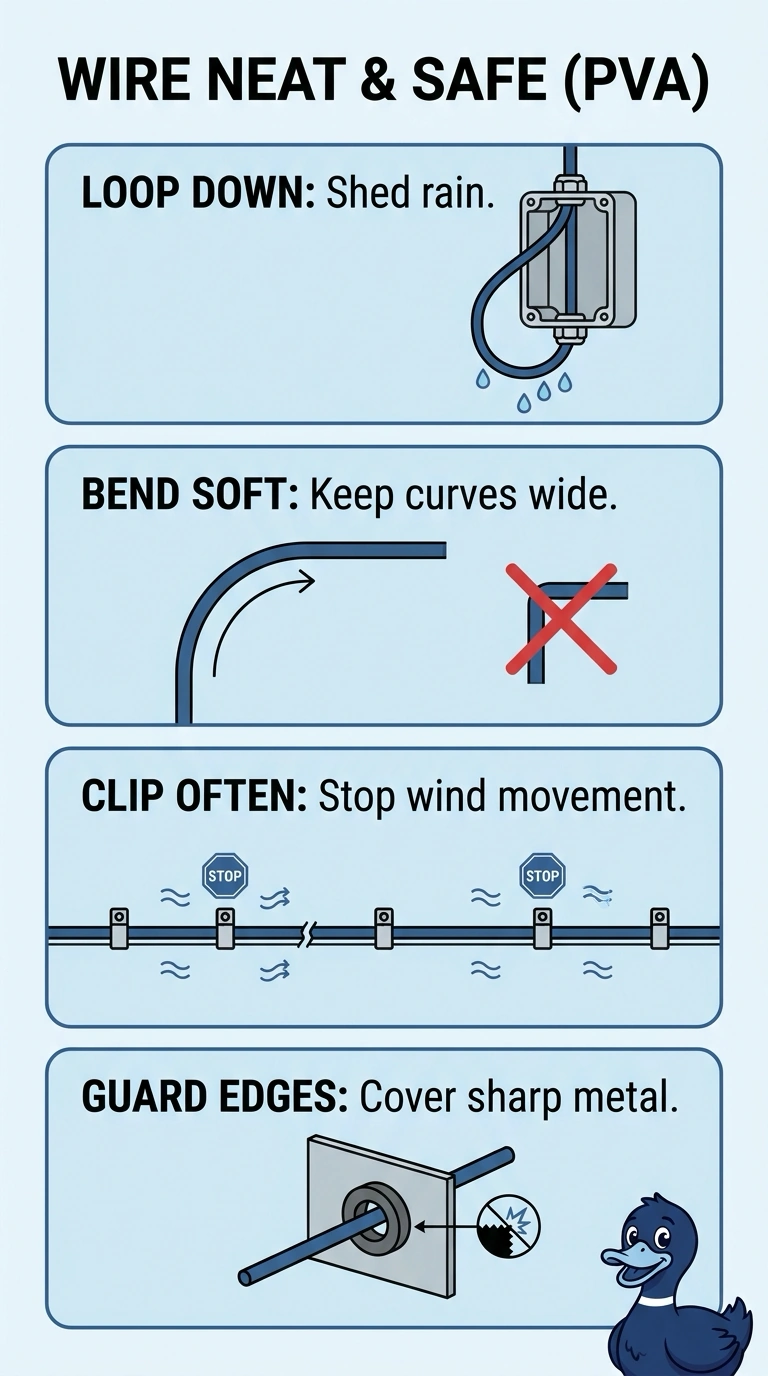
You want the wiring to be like a well-supported garden hose: form drip loops, use gentle bends, secure cables at intervals, and protect them from sharp edges. You’ll help water drain away and prevent strain or damaged insulation.
Full Explanation
Forming drip loops, keeping bends gentle, securing cable at intervals, and guarding sharp edges best addresses the conditions in the plan. Drip loops help direct water away from equipment entries, gentle bends protect conductors and maintain an appropriate bend radius, regular support limits movement in wind, and guards or bushings protect insulation at sharp edges and knockouts. The method that omits drip loops still includes gentle bends, support, and edge protection, but leaves water a direct path toward entries—an important concern where rain can pool. The method that uses compact bends at transitions includes drainage, support, and edge protection, but compact turns can violate the required bend radius or stress conductors; a neat-looking turn is not necessarily gentle. The method that provides support only at boxes and direction changes includes drainage, gentle bends, and edge guards, but may leave long spans inadequately restrained against wind movement. Exam caveat: exact support spacing, bend limits, and entry protection depend on the wiring method, cable type, equipment instructions, and applicable electrical code; do not infer a universal spacing from this question. Practical check: walk the installed route and verify each low point drains away from entries, bends meet the specified minimum radius, supports are appropriately spaced, and no conductor contacts an unprotected sharp edge.