
A homeowner in Raleigh wants a quick quote for a 7-kW roof system. The south roof is 18 years old with worn shingles, a 35-degree pitch, and a tall oak shading it until 11 a.m. The west roof is newer and open. Which preliminary system estimate best assesses shading, roof type and age, orientation, and pitch?
Select an answer to reveal the explanation.
Short Explanation
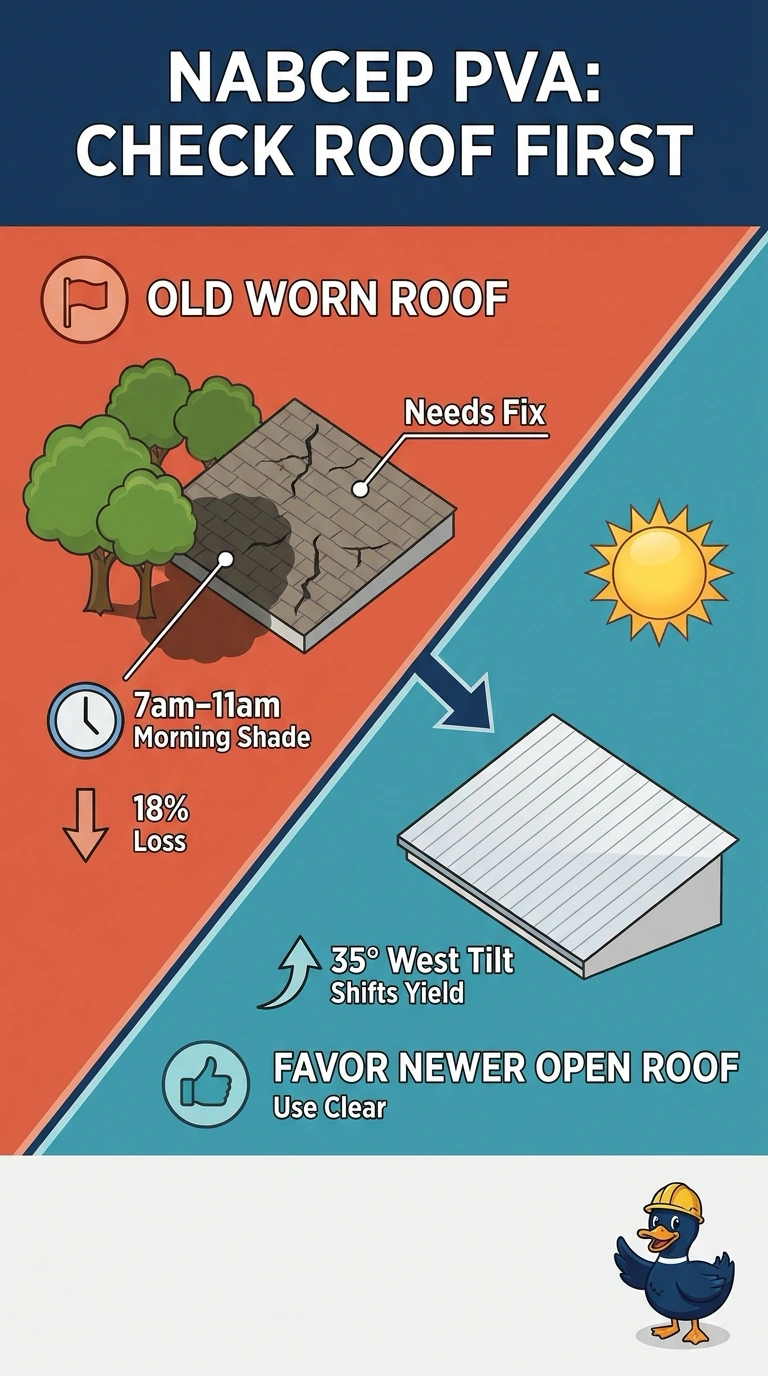
Good estimating starts on the roof, not in the spreadsheet. You’re weighing age, shade, orientation, and pitch, and the newer, open west roof is the better preliminary choice. Catching the worn shingles and oak shade early can help you avoid a costly redo.
Full Explanation
The best preliminary estimate is site-specific, rather than assuming the nominal 7-kW system will perform identically on either roof. The south roof’s worn shingles make age and condition relevant to installation timing and possible replacement costs, while the oak’s morning shade can reduce production. Favoring the newer, open west roof avoids those concerns; its west-facing orientation and measured pitch should still inform the production estimate. Modeling the south roof’s oak shade, age, and south-facing azimuth but using a standard pitch assumption overlooks the stated 35-degree pitch, which can affect expected output. Modeling the south roof’s pitch, shade, and azimuth while assuming its worn shingles need no allowance misses an important roof-condition and age consideration. Using the newer, open west roof and accounting for its condition and measured pitch is sensible, but treating it as south-facing misstates its orientation and can distort expected production. Exam caveat: a preliminary estimate is not a guaranteed energy yield; shading, roof condition, and production assumptions need verification before a final proposal. Practical check: inspect both roof planes, confirm each plane’s azimuth and pitch, assess shingle condition, and map the oak’s seasonal shadow during a site visit or with suitable imagery.