
A family with 9,400 kWh of bills last year plans to buy an EV in six months and runs most loads evenings with higher summer cooling. They want a fair rooftop estimate now. Which preliminary estimating method should the associate use to account for current and anticipated usage and daily/seasonal profile?
Select an answer to reveal the explanation.
Short Explanation
Homes rarely use power in a flat line, especially with an EV coming. Blending history plus future load gives you profile like planning meals for guests who arrive late.
Full Explanation
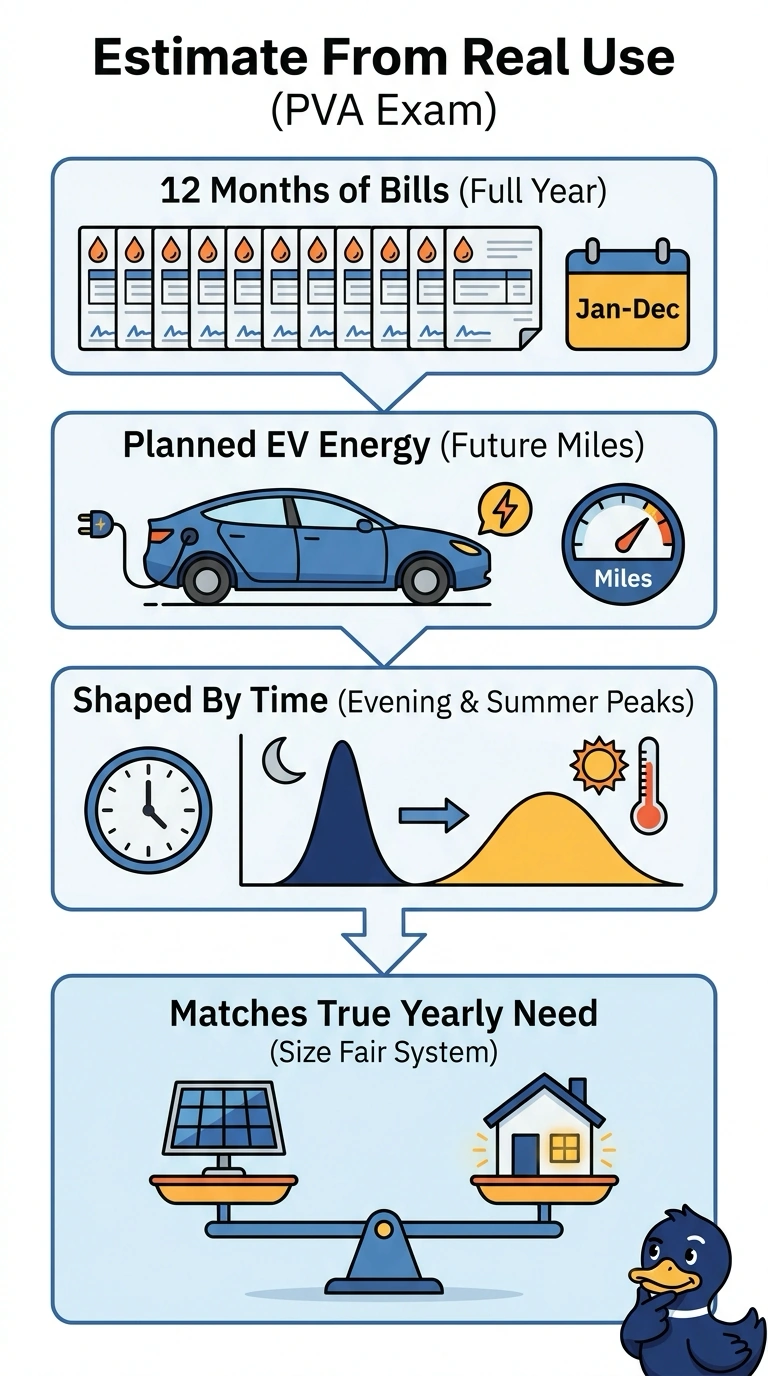
The correct method uses a full year of bills to capture the household’s actual annual consumption and seasonal variation, then adds the expected EV energy and shapes the estimate around evening use and summer cooling peaks. This gives a fair preliminary picture of both how much energy the home may use and when that demand occurs. Using twelve months of bills and interval data to model evening and summer peaks is a sound way to characterize current demand, but omitting the planned EV load understates future consumption and may undersize the estimate. Combining annual bills with planned EV charging and evening shaping addresses current use, future charging, and the daily profile; however, applying no seasonal adjustment misses the stated summer cooling pattern and can misrepresent peak-period needs. Adding EV energy and summer cooling adjustments to annual bills captures future usage and seasonality, but treating every day as a flat load discards the evening concentration that matters to the requested daily profile. A preliminary estimate is not a final system design: results depend on assumptions about charging frequency, charging time, and equipment efficiency. As a practical check, confirm the billing period and annual kWh, then document the EV’s expected miles and charging schedule and compare them with any available interval data.