
You review permit plans for a 40-kW commercial rooftop with three inverters and 12 strings where crews confuse conduit runs, phase balance, and string polarity. The set has one-line, three-line, and string wiring sheets. Which diagram interpretation best assigns each sheet to its troubleshooting use?
Select an answer to reveal the explanation.
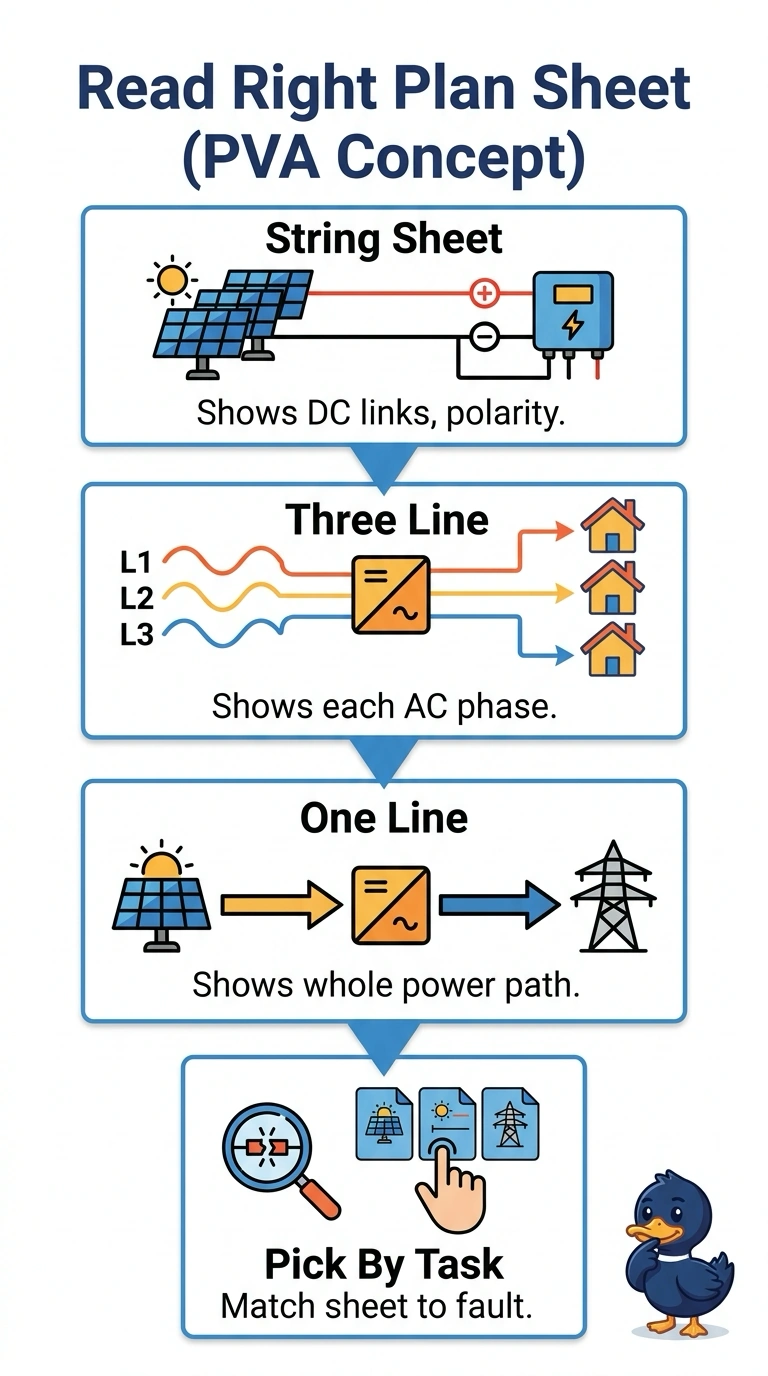
Short Explanation
You're giving each map its right job so crews stop mixing wires. Correct sheet use works like neighborhood, street, and house maps guiding you from site flow down to each wire.
Full Explanation
Plan hierarchy matches detail to task: the one-line shows simplified power flow from array through disconnects, inverters, and service without phase detail, the three-line expands AC phases to verify balanced loading and conductor routing, and the string or DC wiring diagram details module series connections, polarity, homeruns, and combiner terminations. Reversing one-line and string functions asks a block overview to resolve polarity, which it does not show, while wasting detailed DC sheets on system overview. Assigning phase balance to the one-line fails because the one-line collapses phases into a single path and cannot reveal imbalance. Assigning string polarity to the three-line fails because the three-line focuses on AC distribution rather than DC source-circuit detail. For the exam, pair string with DC polarity and combiners, three-line with three-phase AC balance, and one-line with overall scope and disconnect sequence. On site, confirm sheet revisions, ring out polarity before landing, and mark as-built changes on the matching sheet.