
A new helper on a 8-kW home install asks why the modules produce DC power in full sun even though they stay relatively cool to the touch in a breeze. Which explanation of the photovoltaic effect best answers that question?
Select an answer to reveal the explanation.
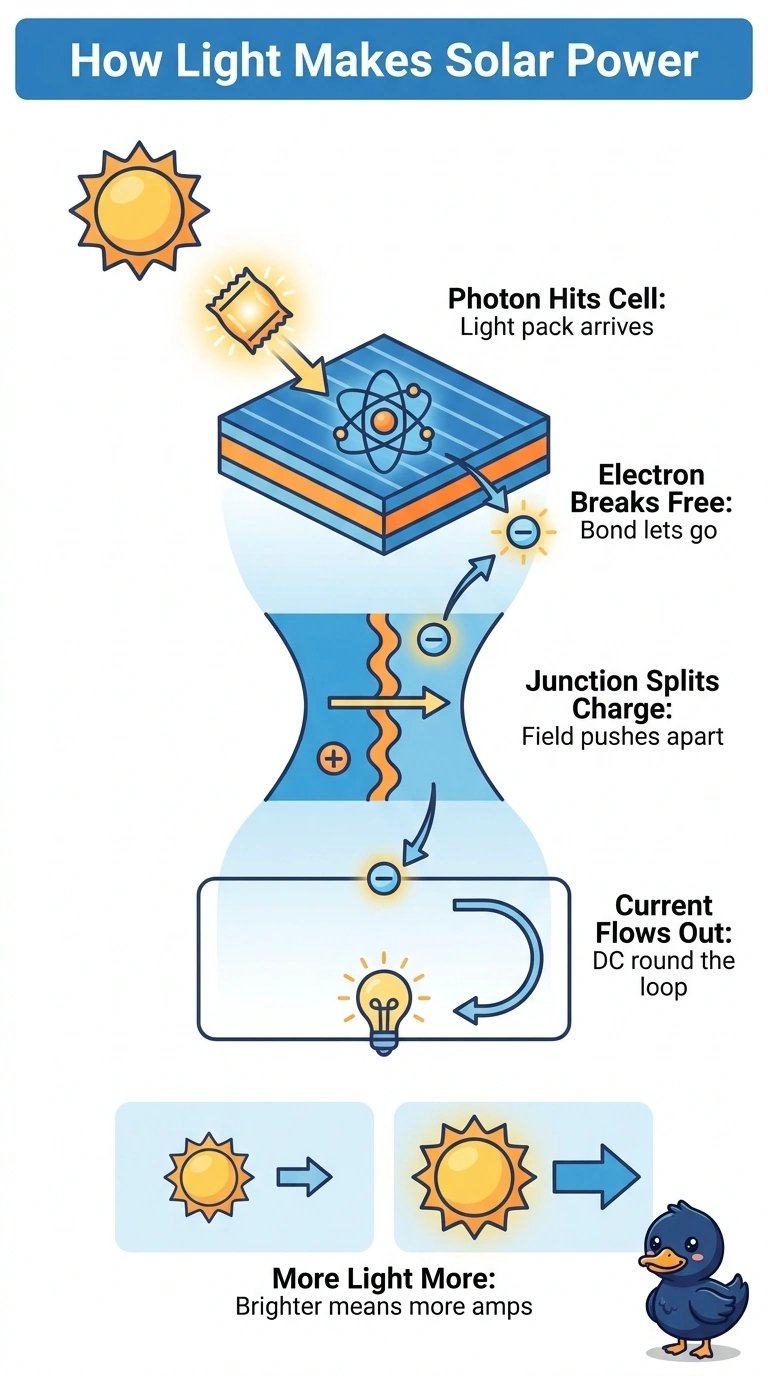
Short Explanation
Your modules don’t need to get hot to make electricity; sunlight works more like a stream of tiny nudges than a heater. Absorbed photons free electrons across the cell junction, and their movement produces direct current.
Full Explanation
The photovoltaic explanation is that absorbed photons create mobile electron–hole pairs in the semiconductor, and the cell junction’s built-in electric field separates those charges. Their movement through an external circuit produces DC directly; the modules do not need to become hot. Increased silicon conductivity under light is photoconductivity, but the proposed external bias is the mismatch: an illuminated photovoltaic junction generates its own voltage rather than requiring an applied bias to deliver power. A temperature gradient can produce DC through a thermoelectric effect, but that attributes module output to heat-driven charge-carrier movement, not photon absorption and charge separation at the junction; a cool module in moving air does not establish that mechanism. Sunlight can also heat a working fluid in a solar-thermal system, with a generator and rectifier supplying DC. That process converts heat through a separate plant and generator, so it does not explain the photovoltaic modules’ own DC output. Exam caveat: “relatively cool” does not mean cells are at ambient temperature or that output is independent of temperature; cell temperature can affect efficiency. Practical check: measure voltage and current at the module’s DC leads in sunlight using appropriately rated equipment and following the manufacturer’s safety procedure.