
Commissioning of a 16-kW ground-mount array on a clear morning shows five inverter inputs reading about 420 V, one input reading 0 V, and a thermal scan showing one combiner connector 35 °C hotter than its neighbours. The associate wants to clear both findings in a single pass. Which measurement should come first to locate the dead string?
Select an answer to reveal the explanation.
Short Explanation
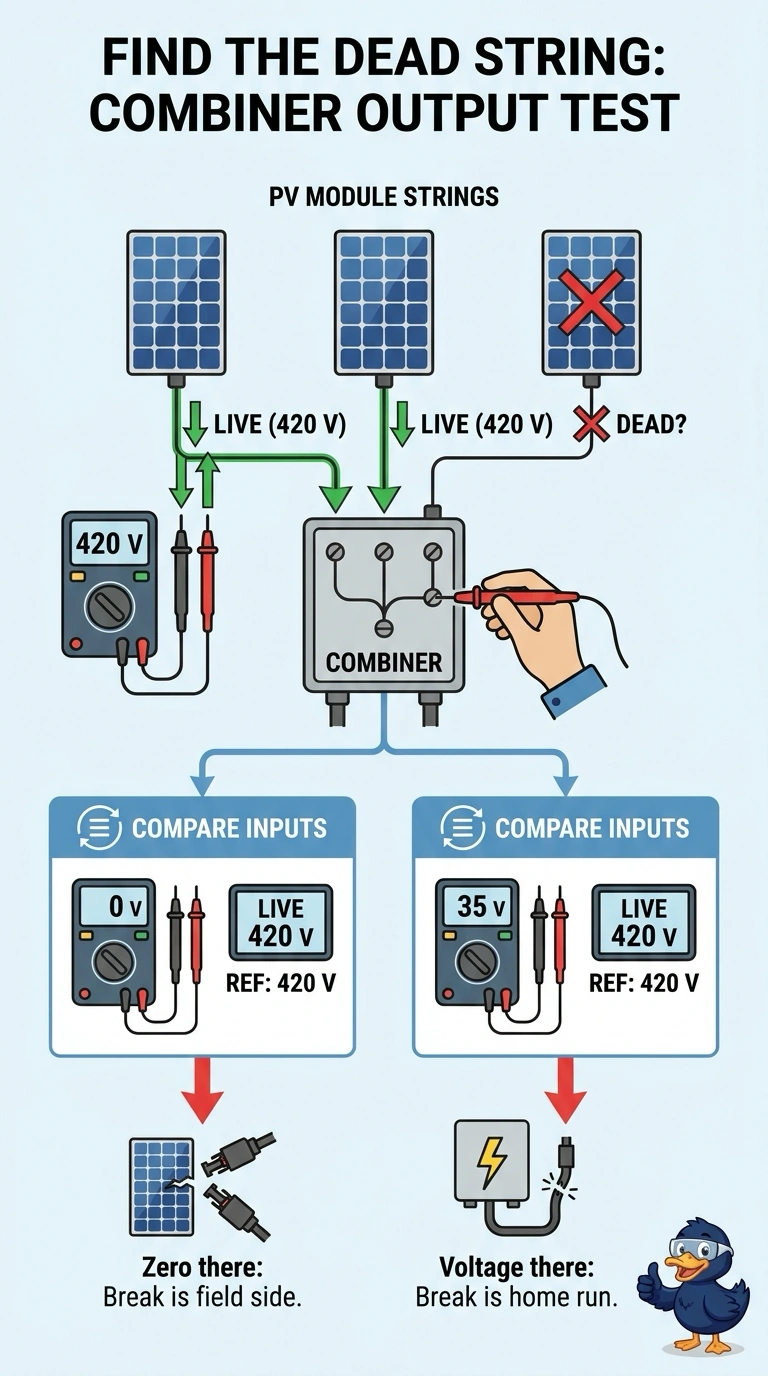
A zero-volt input means the circuit's broken somewhere, and the quickest way to find a break is to cut the circuit in half. Probe the combiner and you instantly know whether to dig in the field or in the home run, like checking both ends of a tripped extension cord. The warm connector waits its turn, because a hot spot shows up only where current flows.
Full Explanation
An input reading zero volts is an open circuit somewhere along that string, and the fastest way to find an open is to cut the circuit in half. Measuring at the combiner output tells you immediately whether the break sits in the field wiring or in the home run, which is why localization comes before any repair. Re-seating the warm connector fails the isolation requirement: it clears the thermal finding but leaves the dead input exactly as unmapped as it was, so you still have no idea where the stop is. Scanning the conduit run with a thermal camera fails on physics, because an open string carries no current and a circuit with no current cannot generate the heat an infrared camera would show. Running an insulation-resistance test fails on purpose mismatch, since a megger finds leakage to ground rather than an open, so it cannot sort field wiring from home run. Exam caveat: live DC strings need insulated probes, rated leads, and gloves, so suit up before you probe. Practical check: test your meter on a known live source first, then probe the dead string at the combiner output and compare it against a known-good string.