
A rural clinic director worries about multi-day storm outages spoiling vaccines and closing exam rooms. The site has a grid-tied PV array with no storage, and staff ask how solar helps security. Which explanation correctly describes reliability and resiliency for this site?
Select an answer to reveal the explanation.
Short Explanation
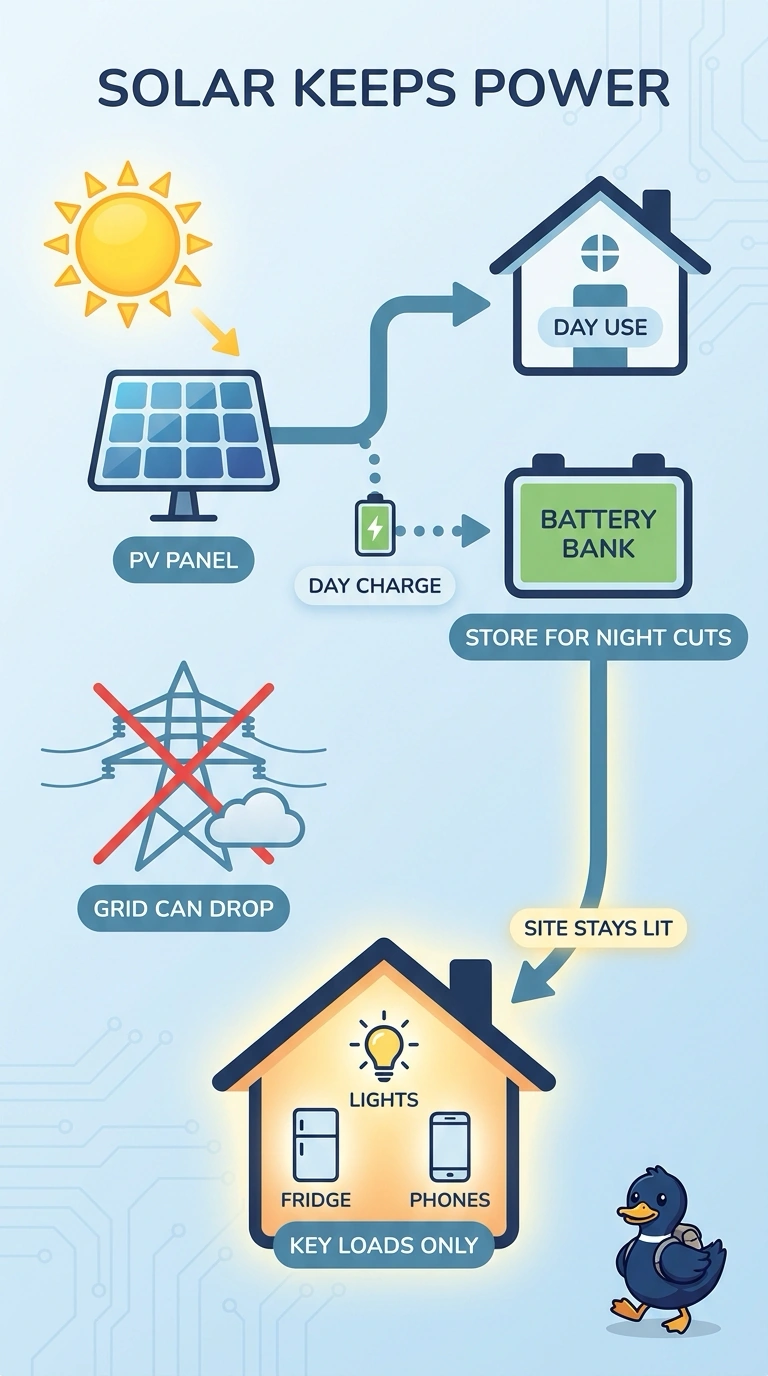
You're giving them straight talk when care is on the line. Real resiliency means stored sun powering key loads after dark, like a pantry stocked before a storm. Solar alone naps when the grid naps.
Full Explanation
The correct explanation is right because resiliency requires generation plus usable stored energy with safe islanding to separate from a failed grid and serve a defined critical-load panel, so properly sized PV plus storage can carry vaccine refrigeration and exam-room circuits through overnight periods and variable weather during a multi-day storm outage, while reliability alone concerns day-to-day continuity under normal grid operation. One incorrect explanation fails on physics and operating limits because grid-tied PV without storage produces only when irradiance is available and cannot carry overnight or extended cloudy-period loads, so vaccines remain at risk after sunset despite useful daytime production. Another incorrect explanation fails on sizing and use case because a system optimized for daily peak shaving has limited power and energy capacity and lacks reserve and load-prioritization logic, so it cannot sustain critical loads for many days without autonomy calculations, larger usable capacity, and conservation protocols. The remaining incorrect explanation fails on interconnection control because PV plus storage without intentional islanding, transfer switching, and critical-load separation must disconnect during outages for anti-islanding safety and therefore cannot ride through even with ample energy on hand. A key exam caveat is to distinguish bill savings and normal-operation reliability from outage resiliency and to remember that grid-tied inverters shut down when the grid de-energizes unless listed islanding equipment is present. A practical check is to verify islanding capability, critical versus non-critical panels, usable kilowatt-hour reserve and days of autonomy, then test transfer, refrigeration temperature logs, and start-up surges under simulated outage conditions.