
You are lead for a one-day ground-mount install on an open lot next to a school walkway in Austin. Curious pedestrians cut through, and small tools sit near the trench. The safety plan calls for access control. Which control best meets the fencing or screening requirement to control site access?
Select an answer to reveal the explanation.
Short Explanation
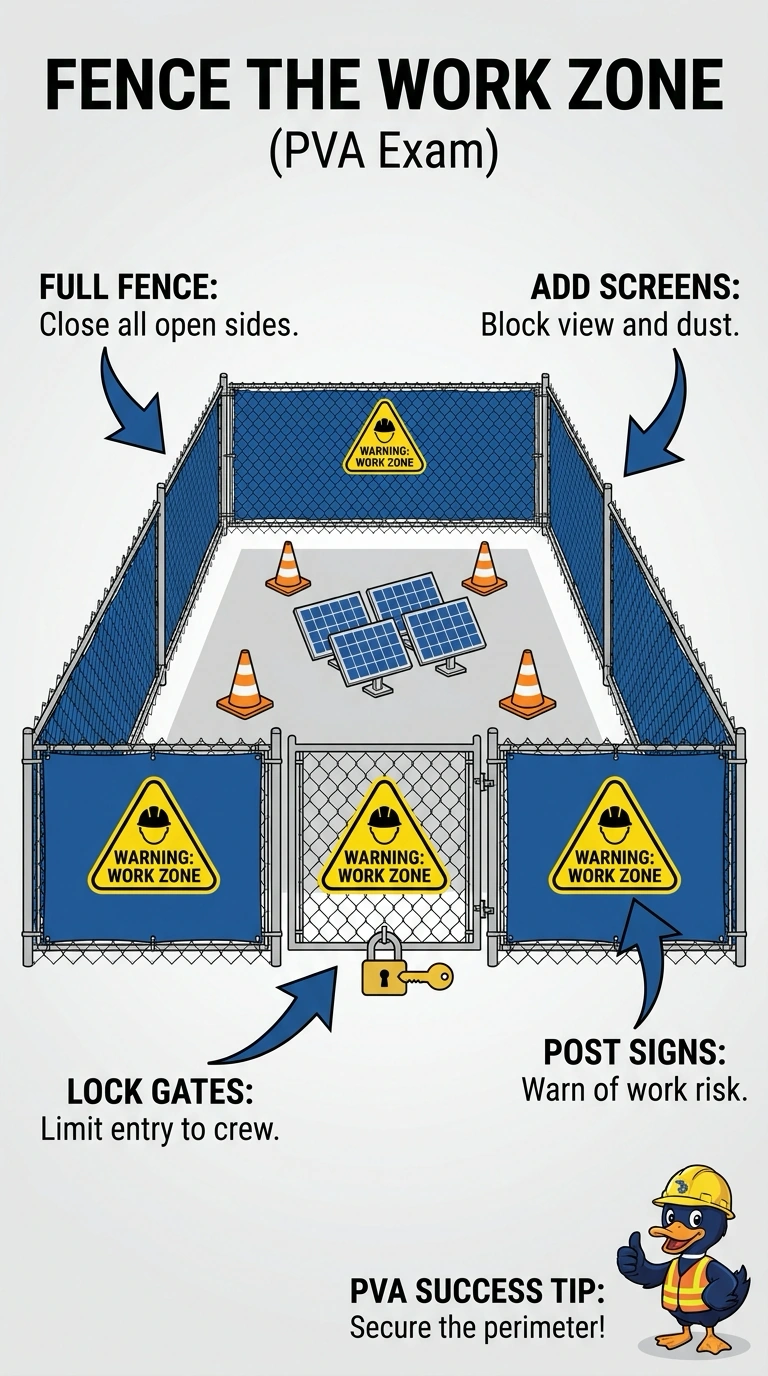
You’re protecting more than the work area—you’re keeping curious pedestrians out of harm’s way. Locked fencing with continuous screens and clear signs makes the boundary secure and easy to recognize. Check that every gate stays locked during work.
Full Explanation
Locked perimeter fencing with screens and signs best controls access because it establishes a physical boundary, helps prevent pedestrians from entering work zones, and makes the restriction visible beside the school walkway. Locked fencing with screens but no warning signs leaves people without clear notice that entry is prohibited or that the area is hazardous. Fencing, screens, and signs do not provide effective access control if pedestrian gates are left unlocked during active work, because the public can still enter through them. Locked fencing with signs but no screening along the school-facing boundary misses the specified screening feature where curious passersby are most likely to approach. Exam caveat: screening is not a substitute for a secure fence or gate, and local rules or the project safety plan may prescribe particular heights, materials, or signage. Practical check: walk the entire boundary before work starts, especially the school side, and verify that screens are continuous, signs are visible, gates latch and lock as intended, and no gaps provide a route into the trench or tool-storage area.