
A new installer asks why a silicon module makes DC power in daylight with no moving parts. You explain the cell has p-type and n-type layers forming a junction, photons strike the silicon, and meter leads read voltage and current. Which description correctly explains the photovoltaic effect behind this reading?
Select an answer to reveal the explanation.
Short Explanation
You nailed the heart of solar — light kicks charges loose. Junction separation does the quiet work, like a one-way gate sorting folks into lines.
Full Explanation
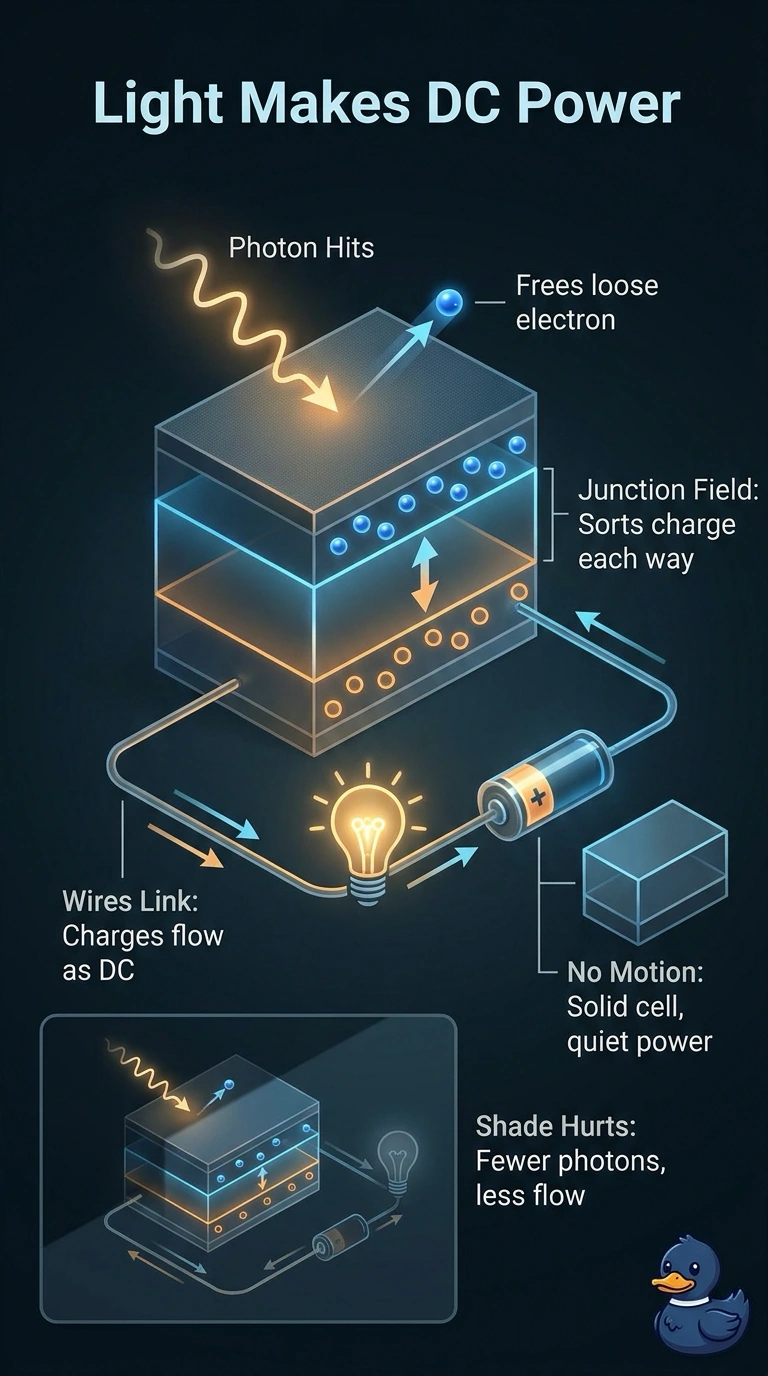
The correct description is the photovoltaic effect: absorbed photons generate mobile electron–hole pairs in the silicon, and the built-in electric field at the p–n junction drives the two carrier types in opposite directions. This separation establishes a voltage; when a load completes the circuit, the carriers produce direct current without mechanical motion. A silicon photoconductor also uses light to increase carrier density, but its usual operating principle is that an externally applied field drives current through the illuminated material. It does not explain a module’s self-generated voltage and current through junction-field separation. The Seebeck effect is a genuine way to generate DC without moving parts: a temperature difference produces a voltage in suitable semiconductor junctions. But it converts a heat gradient, not photons generating and separating carriers, so it does not account for the stated light-driven cell operation. A Schottky-barrier solar cell can use photon-generated carriers and a built-in barrier to produce current, but its operative junction is metal–semiconductor, not the stated p-type/n-type silicon junction. Exam caveat: photovoltaic cells can have other architectures, so a mechanism valid for a different cell design need not describe this one. Practical check: measure the module’s open-circuit voltage in light and compare it with the voltage in darkness; light-dependent voltage supports photovoltaic generation, while a thermoelectric signal should track a temperature difference.