
You maintain a 250-kW rooftop with bifacial modules where output dropped 8% on clear windy days. The pyranometer looks dusty and tilted, no rear-irradiance data exists, and wind logs are missing. Which weather sensor action best diagnoses irradiance, bifacial gain, and cooling effects?
Select an answer to reveal the explanation.
Short Explanation
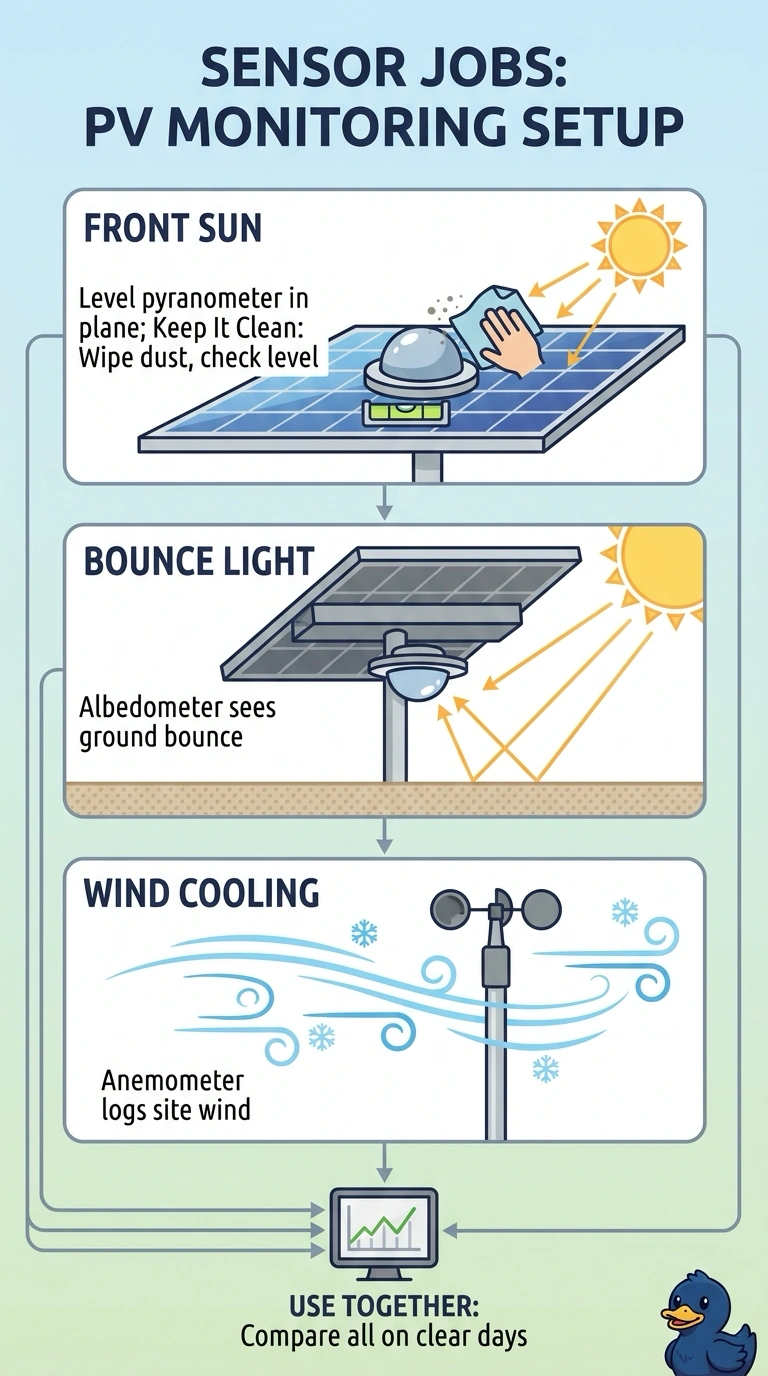
You've got three clues and you need three tools to match them. A clean, level plane-of-array pyranometer nails front sun, the albedometer catches bounce light, and wind explains cooling like a breeze on hot soup.
Full Explanation
The correct approach restores a trustworthy plane-of-array (POA) irradiance reference, measures rear-side irradiance needed to assess bifacial contribution, and records local wind to investigate module cooling. Cleaning and leveling matter because dust and angular misalignment can bias irradiance readings; an anemometer provides wind observations at the rooftop rather than a proxy. A horizontal pyranometer is a valid instrument for global horizontal irradiance, but it does not measure the plane-of-array resource on a tilted rooftop, so it misses the required front-side reference. Nearby weather-station wind records are commonly useful for context, but they may not represent rooftop exposure, turbulence, or local wind speed; with site wind logs missing, they cannot establish the cooling conditions at this array. A second front-facing pyranometer can improve redundancy or compare front-side measurements, but it still provides no rear irradiance measurement, so bifacial gain remains unquantified. Exam caveat: a rear albedometer’s placement and field of view must suit the module layout and ground conditions; a single reading may not represent the whole array. Practical check: after installation, verify sensor orientation and leveling, compare the cleaned POA sensor against a calibrated reference, and confirm synchronized timestamps and plausible wind readings in the logger.